
Contextual article
What Is MBTI? Meaning, Four Letters, 16 Types, and Limits
21 min read
· By itypelab Editorial Team
· 2026-07-31
· Updated 2026-08-05
A direct, practical explanation of MBTI, its four preference pairs, 16 type codes, everyday uses, and important limits.
Best for readers who already know MBTI and want to connect it to real work, relationships, or self-observation.
This article breaks a common MBTI topic into more usable signals instead of stopping at a quick answer.
You'll leave with a clearer interpretation frame and a better sense of whether to continue into a type page, question page, or guide.
MBTI stands for Myers-Briggs Type Indicator. It is a personality questionnaire that describes four pairs of preferences: E/I, S/N, T/F, and J/P. Choosing one letter from each pair creates 16 types, such as INFP, ESTJ, or INTJ.
This page owns the overview: what MBTI is, how the 16 codes form, everyday uses, and hard limits. It does not own the deep letter-by-letter map. For “what do the MBTI letters mean / E I N S F T J P,” go to MBTI letters explained after you finish the short overview below.
Here is a complete example. In a project meeting, one person may talk through an idea with the group (E), ask for the facts already available (S), compare options against the same rule (T), and want a decision before the meeting ends (J). Another may think privately before speaking (I), notice possible future directions (N), consider how each choice affects the people involved (F), and keep options open until more information arrives (P). Both people can speak, use facts, reason, care about others, and make plans. The letters describe what tends to feel more natural first, not what either person is capable of doing.
The four positions are easy to remember: the first describes attention and interaction, the second how information is taken in, the third how decisions are weighed, and the fourth how external plans and unresolved matters are handled. INTJ, for example, is not shorthand for “smart and cold”; it combines I, N, T, and J preferences. If only one letter feels uncertain, use the letters hub instead of discarding the whole result.
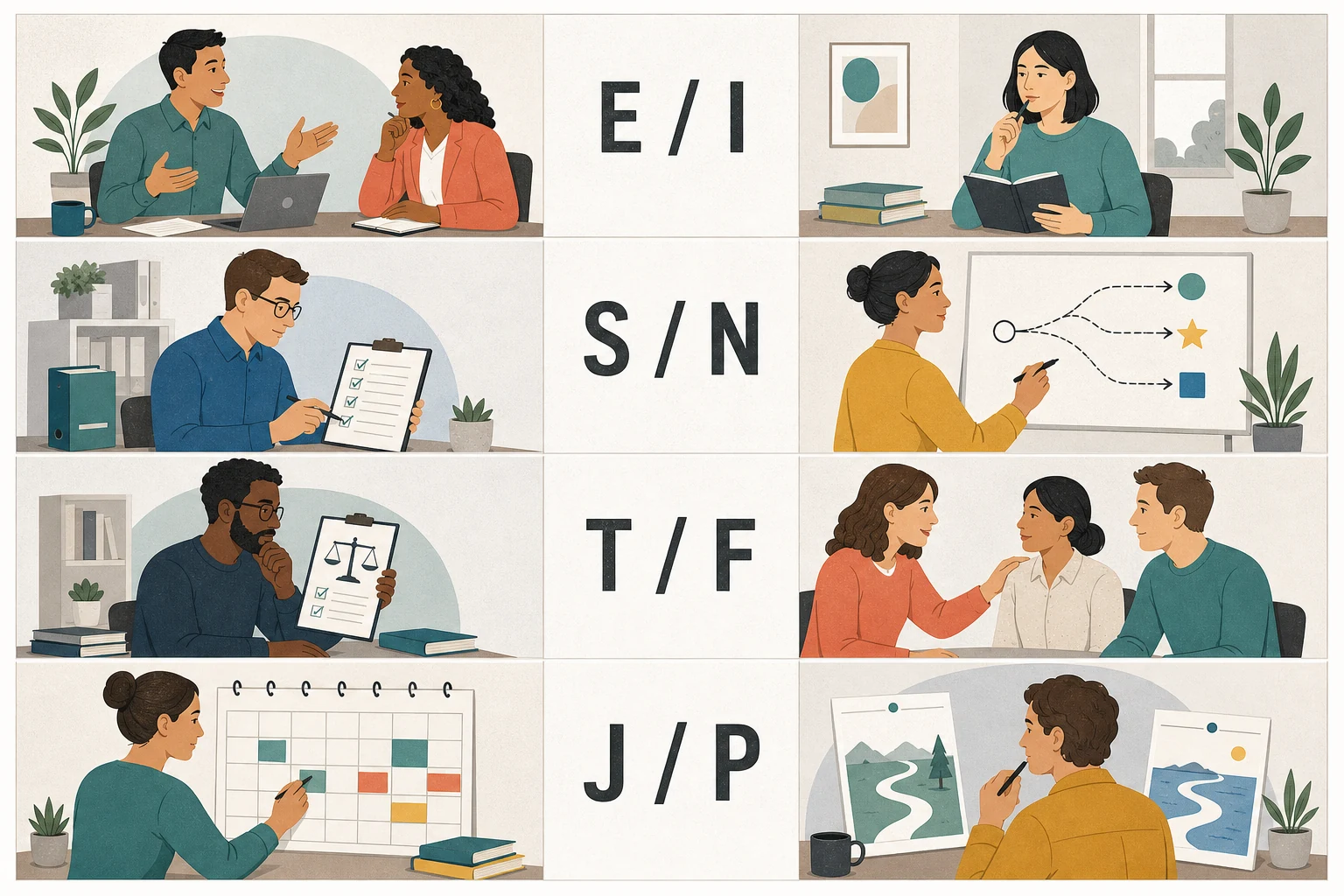
The four pairs in one short view
| Pair | First side often starts with | Second side often starts with |
|---|---|---|
| E / I | Engage outward, then shape the thought | Turn inward, shape the thought, then share |
| S / N | Facts, details, and what is happening now | Patterns, implications, and what could happen next |
| T / F | Rules, causes, and logical consequences | Values, needs, and human consequences |
| J / P | Organize and decide sooner | Explore and leave room longer |
These are preferences, not locked abilities. For pair-by-pair mistakes, scene tests, and where to go when one letter is stuck, use MBTI letters explained instead of expanding the glossary here.
The Myers & Briggs Foundation explains that people use both sides of every pair, even when one side is more natural. Its MBTI basics page is a good primary reference for the four pairs.
How four pairs become 16 types
There are two choices in each of four positions. That gives 2 × 2 × 2 × 2, or 16 possible codes:
| ISTJ | ISFJ | INFJ | INTJ |
| ISTP | ISFP | INFP | INTP |
| ESTP | ESFP | ENFP | ENTP |
| ESTJ | ESFJ | ENFJ | ENTJ |
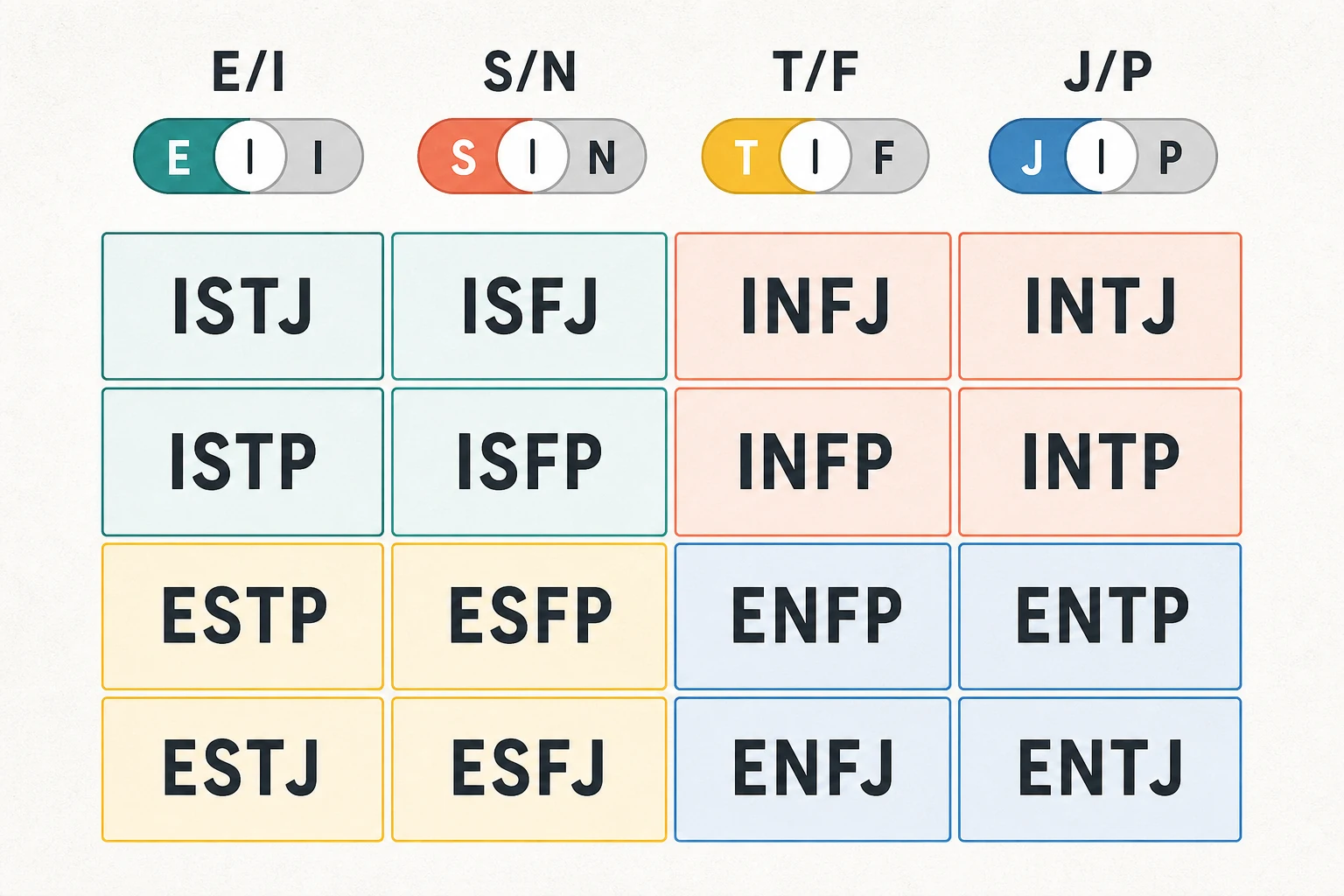
Read a code from left to right. INFP means Introversion, Intuition, Feeling, and Perceiving. ESTJ means Extraversion, Sensing, Thinking, and Judging. The code is a compact index into a longer description; it is not a score and one code is not better than another. The Foundation also publishes a list of the 16 MBTI types.
If one letter is unclear, start with the four-letter guide rather than forcing a full type. You can also browse all type pages after you understand the code.
MBTI, Myers-Briggs, and 16Personalities are not identical names
People often use these names as if they mean exactly the same thing, but there is a practical difference:
- Myers-Briggs usually refers to the framework and the work of Isabel Briggs Myers and Katharine Cook Briggs.
- MBTI is the registered assessment and four-pair type framework.
- 16Personalities is a separate website with familiar type nicknames and an additional Assertive/Turbulent Identity scale. Its own theory page describes five scales. That final A or T is not a fifth standard MBTI letter.
This matters when two results look different. “INTJ” and “INTJ-T” may appear in the same conversation, but the suffix comes from a particular provider. Check what the test actually measured before treating the labels as interchangeable.
Three scenes that show what MBTI can describe
Case 1: A project starts with an unclear brief
Maya asks for the client’s current numbers, examples, deadline, and available staff. Leo asks what larger problem the client may be trying to solve and whether a different product could work better. Maya is showing an S-like starting move; Leo is showing an N-like starting move. Ten minutes later, Maya may imagine options and Leo may demand evidence. The preference is visible in the order, not in exclusive ownership of facts or ideas.
The practical use is immediate: let Maya establish what is known, let Leo expand the possibilities, and then ask both to test the short list. MBTI language helps the team sequence a discussion; it does not prove who has the better idea.
Case 2: A manager has to give difficult feedback
Andre first states the missed requirement, the evidence, and the standard that applies. Nia first checks whether the employee understands the impact and what support would make improvement realistic. Andre’s opening resembles T; Nia’s resembles F. Good feedback needs both: a clear account of the problem and a respectful path forward.
If Andre adds human context, he has not become F. If Nia names a firm consequence, she has not become T. One difficult conversation cannot type either person. Watch which question repeatedly appears first across hiring, budgeting, customer complaints, and personal conflict.
Case 3: Friends plan a weekend trip
Chen wants the train, hotel, and dinner booking settled by Wednesday so everyone knows the plan. Sara wants one confirmed anchor and freedom to choose the rest after seeing the weather. This can resemble J and P. It does not mean Chen is always organized or Sara is always late. J/P is easier to see in how each person handles an open decision than in the neatness of a desk.
They can make the difference workable: book the limited train seats, leave Saturday afternoon open, and agree on the latest time for the remaining decision. Type language is useful when it improves the arrangement rather than excuses poor behavior.
What MBTI can help you do
MBTI can give you a shared vocabulary for recurring differences. It may help you notice why one colleague wants preparation before a meeting while another discovers ideas in conversation; why one partner wants a conflict settled tonight while another wants time to consider; or why two competent people ask different first questions about the same plan.
It can also suggest a better reading route. If your result feels half-right, compare the uncertain letter instead of reading ten full portraits. If the letters are clear but the portrait is generic, compare a nearby type. The result-reading guide explains that process, and the MBTI test provides a starting point if you have not taken one.
What MBTI cannot tell you
An MBTI result does not measure intelligence, professional skill, honesty, empathy, maturity, mental health, or the highest job you can reach. It cannot diagnose anxiety, autism, depression, or any other condition. It cannot guarantee relationship compatibility or justify selecting and rejecting job applicants.
It also cannot explain every behavior. Experience, culture, role, incentives, health, safety, and the immediate situation often matter more. A new employee may stay quiet because the meeting is unfamiliar, not because they prefer Introversion. A nurse may follow a rigid checklist because patient safety requires it, not because they prefer Judging.
Treat the result as a description to test against repeated life, not a permission slip. “I am P, so I miss deadlines” is not useful type reading. “I tend to delay closure, so I will set a decision deadline when other people depend on me” is useful.
A quick next-reading chooser
Use the question that matches your actual uncertainty:
1. I do not know what one or more letters mean. Go to MBTI letters explained. 2. I am unsure whether I am E or I. Compare attention, thinking aloud, and recovery in the E/I guide. 3. I have a four-letter result but it feels generic. Use the result-reading guide and compare a nearby type. 4. I have never taken a test. Start with the full personality test, then check the result against ordinary behavior over several days.
The shortest accurate definition is this: MBTI is a four-pair personality-preference framework that produces 16 type codes. Its value is in making repeated differences easier to discuss. Its limit is equally important: a four-letter code describes preferences, not a person’s worth, ability, diagnosis, or future.
Related reading
Is MBTI Accurate? Research Limits, Predictive Validity, and How to Use It
MBTI can describe preference patterns; it is a weak predictor of performance, romance, or clinical outcomes. This guide separates descriptive value from predictive validity.How do I know if an MBTI type description is too generic?
A question-style checklist for spotting MBTI type descriptions that feel recognizable but not very informative.Why Your MBTI Result Keeps Changing: 4 Real Causes
Four real causes of MBTI result variation, and how to tell which type of change is meaningful versus situational noise.Keep exploring
Take the test to see your type, or browse more MBTI guides and answered questions.