
Contextual article
MBTI Introvert vs Extrovert: Attention, Thinking, and Recovery
35 min read
· By itypelab Editorial Team
· 2026-06-01
· Updated 2026-07-31
A practical E/I comparison that goes beyond shyness and the familiar recharging metaphor.
Best for readers who already know MBTI and want to connect it to real work, relationships, or self-observation.
This article breaks a common MBTI topic into more usable signals instead of stopping at a quick answer.
You'll leave with a clearer interpretation frame and a better sense of whether to continue into a type page, question page, or guide.
MBTI Extraversion (E) and Introversion (I) differ in more than social energy. E more often directs attention toward people, activity, and what is happening outside; I more often directs attention toward private thoughts and impressions. E often uses speech to think an idea into shape, while I often wants to think first and speak once the idea is clearer. After a meeting-heavy day, E may want more exchange and I may want quiet recovery. In an unfamiliar group, E may enter through interaction while I first watches and finds a useful opening.
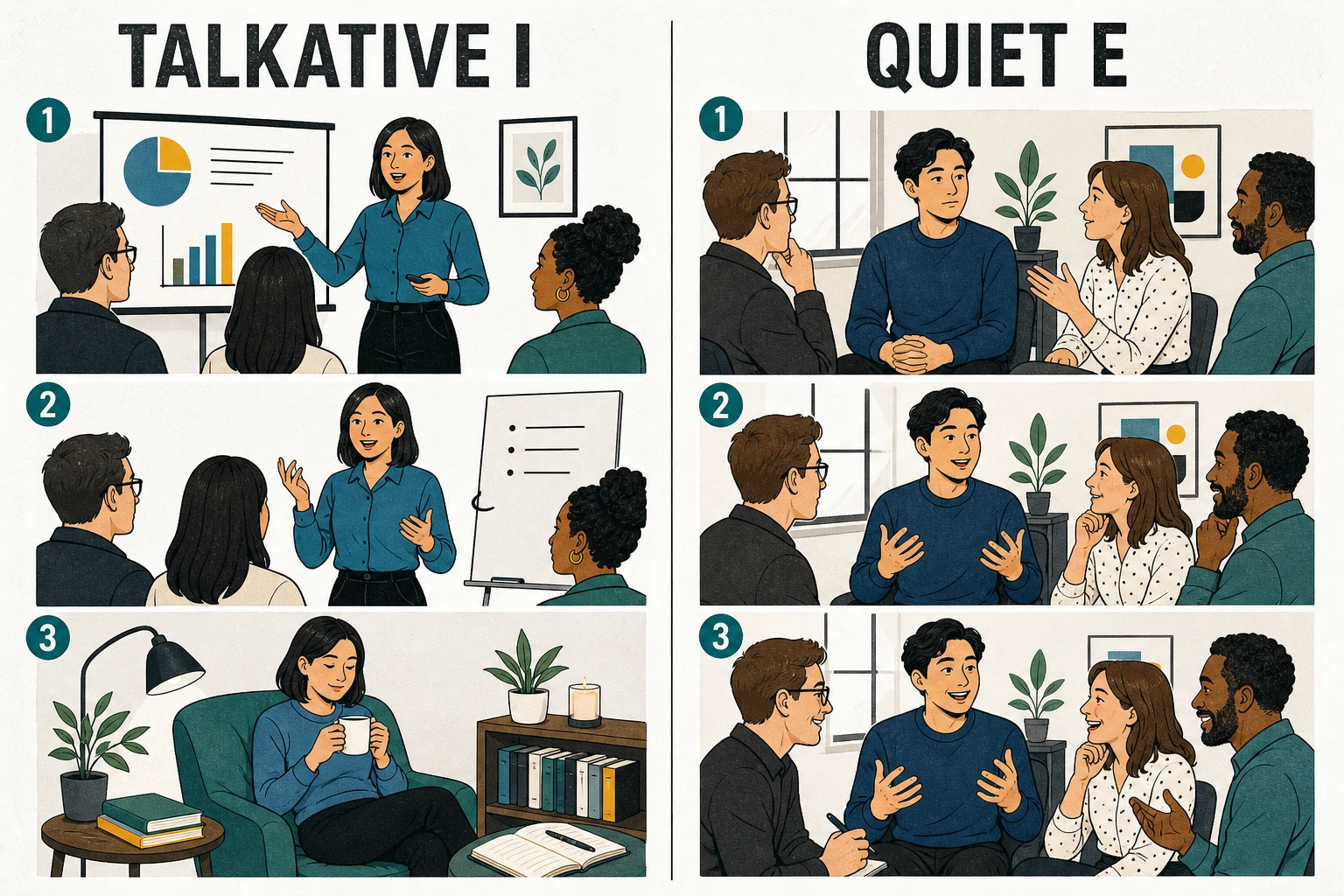
A week with too much solitude can leave many E-preference people under-stimulated; a week with too much social input can leave many I-preference people mentally crowded. But appearance alone can mislead: a talkative Introvert may be skilled and enthusiastic, while a quiet Extravert may be listening, cautious in a new group, or simply tired. Look for the repeated direction of attention, thinking process, and recovery need rather than counting words.
Use four quick checks: in meetings, do you talk to think or think before speaking; with unfamiliar people, do you enter through interaction or observe first; after dense interaction, do you want more exchange or quiet; after several solitary days, do you feel clearer or start seeking outside stimulation? The side that repeats across work, home, and friendships is more useful than one isolated match. One check alone cannot establish E or I.
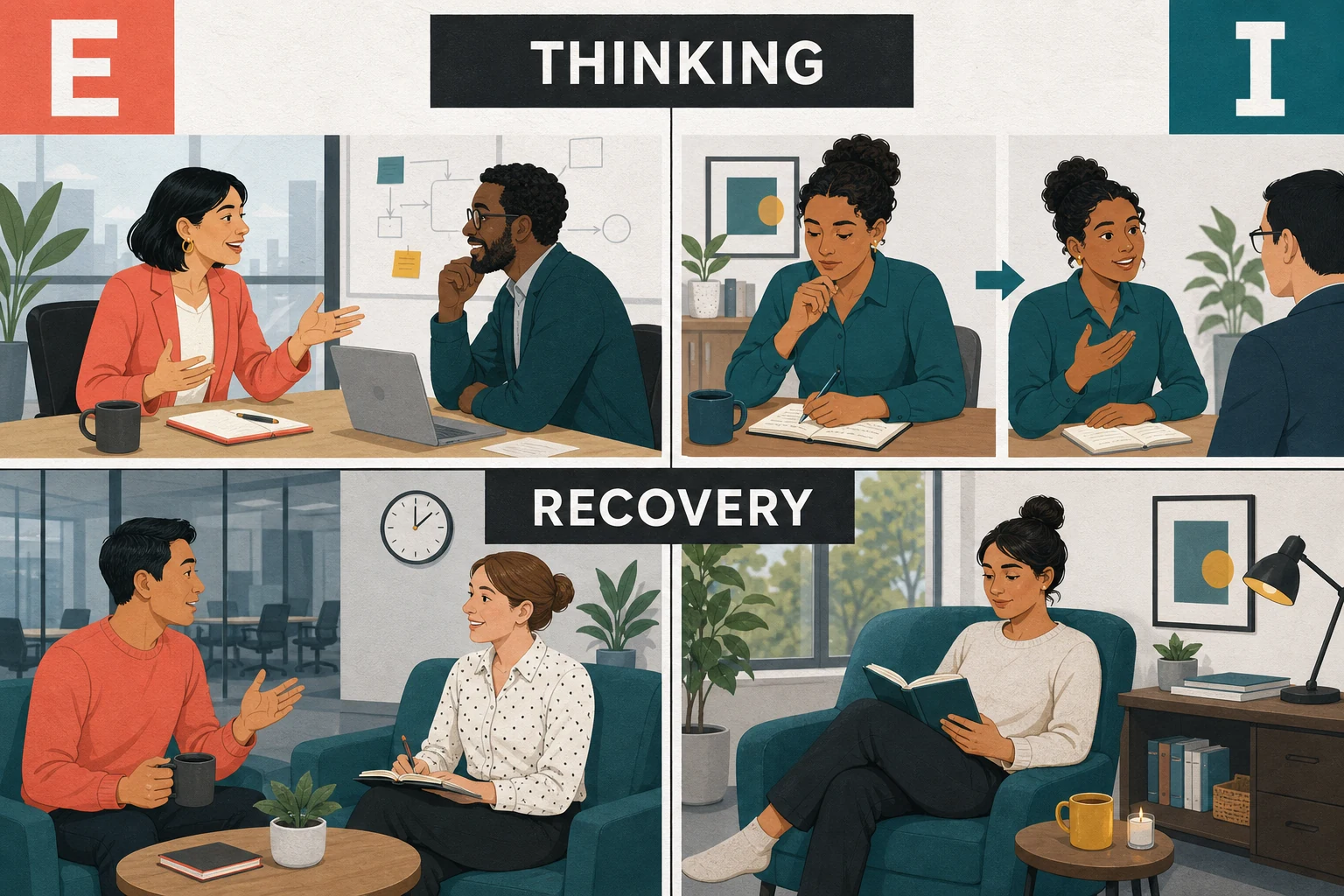
Why “where you recharge” is useful but incomplete
“Recharge” is a convenient metaphor, not a physical law. Enjoyable conversation can tire an Extravert, and an Introvert can leave a focused one-to-one exchange energized. Sleep, workload, anxiety, sensory load, familiarity, health, and whether the interaction had a purpose all affect the result. Use recovery together with two other checks: where attention went first and how the person formed a thought.
The Myers & Briggs Foundation describes the outer-world and inner-world orientations and talk-think patterns on its E/I preference page. It also states in MBTI basics that people can use both sides. A single party, presentation, or quiet weekend cannot settle the letter.
The Most Common Misconception
Popular culture has defined introvert and extrovert in ways that bear only partial resemblance to the MBTI definitions. In everyday use:
- "Introvert" has come to mean shy, quiet, socially anxious, or antisocial
- "Extrovert" has come to mean outgoing, talkative, confident, and socially dominant
These definitions conflate personality traits that are actually independent of each other. Shyness is a form of social anxiety — a fear of negative social evaluation. It has nothing to do with whether social interaction drains or energizes you. A person can be shy and extraverted (they find people energizing but feel anxious in new social situations). A person can be confident and introverted (they feel no social anxiety but find large gatherings genuinely tiring).
The conflation has real consequences: Introverts are sometimes seen as unfriendly or disengaged, when they are simply managing their energy budget. Extraverts are sometimes assumed to be shallow or unable to focus, when what they're doing is seeking the external stimulation they genuinely need to think and feel their best.
What Actually Happens After Social Interaction
The most concrete way to understand the I/E dimension is to pay attention to how you feel after extended social engagement — not during it, but after.
After a long, stimulating social event (a party, a networking event, a full day of meetings):
Introverts typically feel depleted. They may have genuinely enjoyed the event, had good conversations, and performed socially well — but there is a distinct sense of needing to decompress. They often describe it as needing "recovery time." The thought of continuing social interaction feels heavy; the thought of going home alone feels like relief.
Extraverts typically feel stimulated. They may feel slightly tired from the physical activity of the event, but they often feel mentally and emotionally energized rather than depleted. They might be disappointed when the event ends. The thought of heading straight into another social engagement feels natural, not burdensome.
This difference in the after-state is more diagnostic than behavior during the event itself. Both types can be animated, engaged, and socially effective during interaction. The difference is in the cost and the replenishment mechanism.
Three Scenario Comparisons
Case 1: Team Meetings
Introverted preference: Many people with introverted preferences find that they do their best thinking before or after meetings rather than during them. Open-ended group discussion, especially without an agenda or preparation time, can feel cognitively expensive. They may contribute less in the room but have sharper ideas later — in follow-up emails, in a one-on-one debrief, or after sleeping on it.
Extraverted preference: Many people with extraverted preferences use spoken conversation as a thinking tool. They work out their ideas by talking about them. This means they often arrive at insight during the meeting, through the process of discussion itself. They may say things that are half-formed and revise them in real time, which can look like inconsistency but is actually just a different cognitive style.
Neither pattern is more productive. What creates conflict is when extraverted-preference team members interpret an introvert's silence as disengagement, or when introverted-preference team members interpret an extravert's verbal processing as domination.
Case 2: Social Gatherings
Introverted preference: At a large party with many unfamiliar people, people with introverted preferences often gravitate toward smaller side conversations with one or two people. They may find the sustained multi-front social navigation tiring in a way they can't fully explain. They may leave earlier than they expected — not because they're unhappy, but because they can feel when they're hitting their energy ceiling.
Extraverted preference: People with extraverted preferences often find the same environment stimulating and fun. Moving between conversations, meeting new people, and maintaining multiple social threads feels natural rather than demanding. They may be the last to leave and feel a bit flat on the drive home precisely because the stimulation has ended.
Case 3: Alone Time
Introverted preference: Unscheduled time alone doesn't feel like boredom — it feels productive in a non-task way. Reading, thinking, pursuing a solitary hobby, or simply existing without social demands feels genuinely restorative. People with introverted preferences often describe their alone time as necessary and protect it deliberately.
Extraverted preference: Extended time alone — especially unstructured time — can feel unstimulating or even uncomfortable for people with extraverted preferences. They tend to seek out activity, reach out to people, or find ways to inject external engagement into the situation. This is not neediness; it is a genuine energetic preference for engagement with the external world.
Why Introverts Can Be Excellent Speakers and Leaders
The introvert-as-shy myth breaks down most clearly when you look at effective public speakers, teachers, and leaders who identify as introverts.
Public speaking and leadership are skills — they are developed through practice and experience, and they do not require extraverted energy preferences to execute well. In fact, introverted preferences often bring specific strengths to leadership and public speaking:
- Deep preparation: Introverts tend to prepare more thoroughly because the preparation itself happens in the solitary, inward space where they think best. They often know their material inside out before they step in front of an audience.
- Listening depth: Introverted leaders often listen more carefully in interpersonal interactions, which builds trust and leads to better decisions based on more information.
- Written communication: Many introverts are stronger writers than verbal processors, which serves leadership communication well.
- Deliberate choice of words: Because introverts tend to process before speaking (rather than thinking out loud), what they say in meetings or presentations often carries more precision.
The cost is real — a full day of presenting and networking is likely to require genuine recovery time for an introvert in a way it doesn't for an extravert. But the performance quality during that time is entirely decoupled from the energy cost afterward.
How to Identify Your Own Energy Recharge Pattern
Four questions that help identify where you fall on the I/E dimension:
Question 1: After an intensely social day, what does "recovery" look like for you? If recovery means being alone, having quiet, and avoiding further interaction — that points toward Introversion. If you feel a bit flat after the day and want to call a friend or go to dinner — that points toward Extraversion.
Question 2: How do you prefer to think through a difficult problem? If your best thinking happens alone, in writing, or in sustained private reflection — Introversion. If your best thinking happens by talking it through with someone, even informally — Extraversion.
Question 3: What does an ideal Saturday morning look like if you have no obligations? If the ideal involves solitude, a book, a quiet walk, or uninterrupted personal projects — Introversion. If the ideal involves meeting a friend, going somewhere busy and alive, or calling someone to catch up — Extraversion.
Question 4: When you're depleted and need to recharge fast, what actually works? The answer to this one is particularly telling, because it asks about your genuine felt experience rather than what you think you should prefer. Solitude and quiet, or engagement and connection?
Most people can do and enjoy both solitary and social activities. The question is which direction feels genuinely restorative when you are tired or stressed — not which you are capable of, but which actually fills the tank.
I/E Differences in Daily Work and Relationships
At Work
- Protected blocks of uninterrupted focus time
- Advance notice before meetings and discussions
- Time to process before responding (email and async communication suit them)
- Fewer open-plan office distractions
- Regular interaction with colleagues
- Opportunities to think out loud and collaborate in real time
- Social feedback and recognition
- Varied tasks that involve external engagement
None of this means introverts can't thrive in social roles or extraverts can't do deep solo work. It means each type has environmental conditions where they operate with less friction, and understanding this helps with everything from workspace design to career choices.
In Relationships
- Weekend planning: one partner wants to be social, the other wants to stay in
- After-work needs: one partner needs to debrief conversationally, the other needs quiet decompression
- Party behavior: one wants to stay longer, the other is ready to leave
- Emotional processing: one partner wants to talk through conflict immediately, the other needs processing time before talking
None of these are incompatibilities — they are differences that require conscious negotiation once understood. "I need about 30 minutes of quiet when I get home before I can talk" is a completely workable request when a partner understands it as energy management rather than rejection.
Frequently Asked Questions
Can introverts enjoy being social?
Yes — genuinely and fully. The I/E dimension describes energy management, not enjoyment. An introvert can have a wonderful time at a party, deeply enjoy the company of friends, or love their highly social job. The difference is that after sustained social engagement, they need recovery time in a way extraverts typically do not.
Can someone be both introverted and extraverted?
People who score near the middle of the I/E dimension — sometimes called "ambiverts" — genuinely have access to both modes relatively equally. They may find that context determines which mode is active: solo focused work one day, energized collaboration the next. This is common and does not indicate confusion about the test — it means they sit near the midpoint of the dimension.
Is introversion more common in certain MBTI types?
Introversion appears in eight of the sixteen MBTI types (all types starting with I). It is not inherently connected to any of the other three dimensions. An INTJ is both Introverted and highly structured and analytical; an INFP is both Introverted and values-driven and open-ended. The shared Introversion is about energy recharge; the other letters describe different things entirely.
Does the introvert/extrovert ratio vary across cultures?
Cross-cultural personality research does find some variation in average Extraversion scores across different national samples. Cultural norms also influence how much introversion is stigmatized or celebrated. But the underlying I/E preference dimension appears to exist across cultures — what varies is how it is expressed and valued in different social contexts.
Can introversion change over time?
The I/E preference is considered one of the more stable MBTI dimensions, but people do report shifts over their lifetimes — sometimes toward slightly more Extraversion as they develop social confidence, sometimes toward more Introversion as they age and prioritize selective engagement. These are gradual shifts, not sudden reversals, and they typically reflect genuine development rather than test noise.
- What Do the Four MBTI Letters Mean in Real Life? — how each dimension was defined and what it captures
- MBTI Four Dimensions Explained — A Complete Deep Dive — a complete look at all four dimensions
- Why Your MBTI Result Keeps Changing: 4 Real Causes — the factors that produce different results across time
- Why J and P Do Not Just Mean Organized vs Messy — another commonly misunderstood dimension
- Is MBTI Accurate? Research Limits, Predictive Validity, and How to Use It — a deeper look at MBTI's validity and limits
- Free MBTI test
MBTI introvert vs extrovert: next reading check
Use this section when your real question is close to MBTI introvert vs extrovert, introvert extrovert difference, MBTI I vs E, introvert energy. The useful move is to connect the page to one concrete observation, one adjacent type or letter question, and one next page instead of reading another broad personality summary.
For a wider reading path, pair this page with the type library, the MBTI reading roadmap, and where to read your result deeply.
Related reading
What Do the Four MBTI Letters Mean in Real Life?
A plain-language guide to what the four MBTI letters mean in real life and how to use them before reading a full type description.Is MBTI accurate? What it can help with, and what it should not replace
A question page about MBTI accuracy, usefulness, and limitations.INFJ Personality Deep Dive: Sensitive and Insightful Does Not Mean Mysterious
A deeper INFJ explanation beyond stereotypes, covering cognitive functions, pressure patterns, relationships, work style, and how to decide whether INFJ actually fits.Keep exploring
Take the test to see your type, or browse more MBTI guides and answered questions.