
Contextual article
What Do the Four MBTI Letters Mean? A Clear, Practical Guide
21 min read
· By itypelab Editorial Team
· 2026-06-22
· Updated 2026-07-31
A direct guide to E/I, S/N, T/F, and J/P with ordinary actions and a practical observation checklist.
Best for readers who already know MBTI and want to connect it to real work, relationships, or self-observation.
This article breaks a common MBTI topic into more usable signals instead of stopping at a quick answer.
You'll leave with a clearer interpretation frame and a better sense of whether to continue into a type page, question page, or guide.
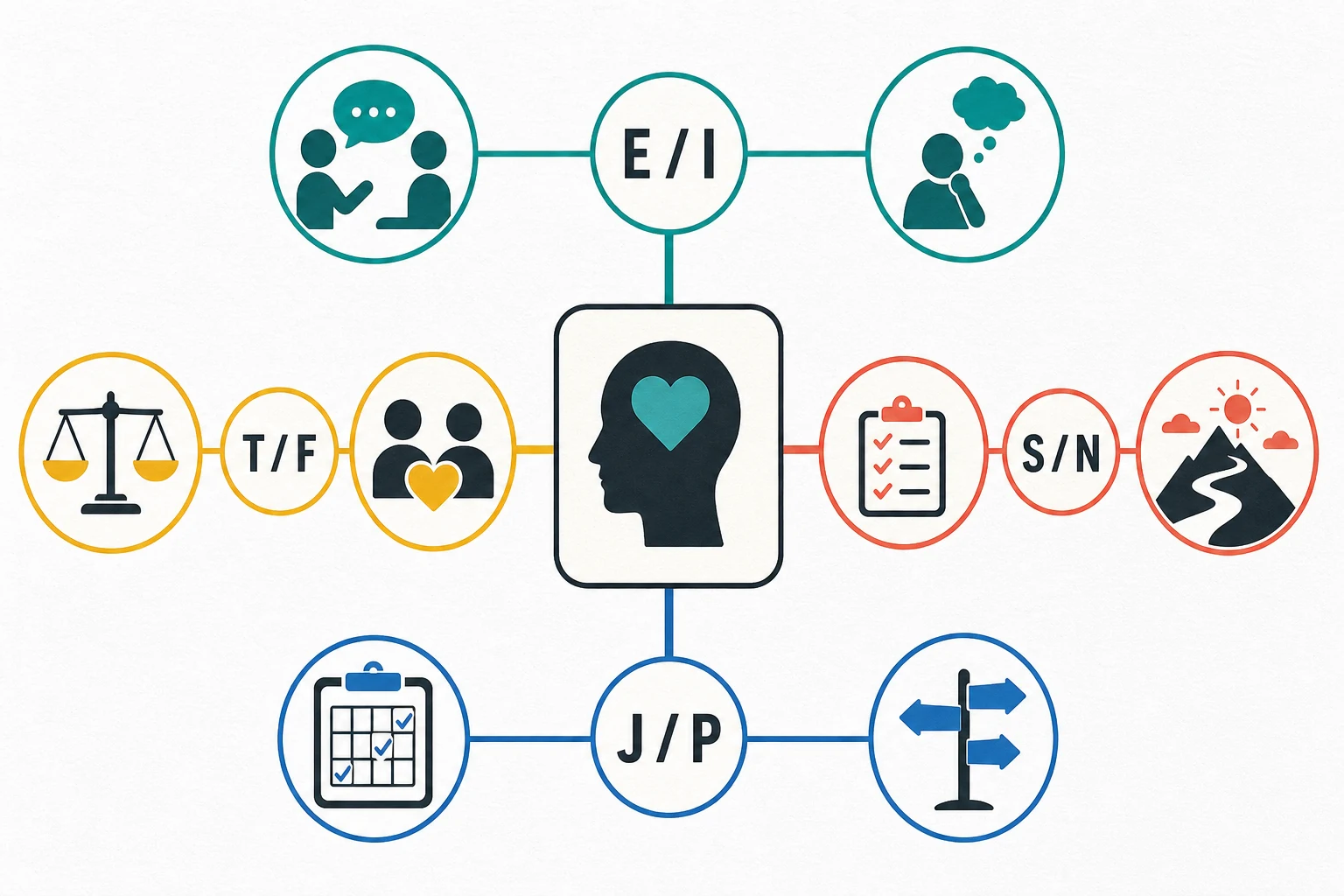
The four MBTI positions are Extraversion (E) / Introversion (I), Sensing (S) / Intuition (N), Thinking (T) / Feeling (F), and Judging (J) / Perceiving (P). In Chinese they are commonly translated as 外倾/内倾、实感/直觉、思考/情感、判断/感知. Each pair points to a practical difference: E/I changes whether you tend to engage first or reflect first; S/N changes whether you begin with concrete facts or possible patterns; T/F changes whether consistent criteria or people and values enter a decision first; J/P changes whether you settle the plan sooner or leave room to adapt longer.
Take INFP as an example. The code reads Introversion, Intuition, Feeling, Perceiving: the person may think before speaking, notice a theme before cataloguing every detail, ask who will be affected before finalizing a decision, and prefer a plan with room to change. None of those actions belongs only to INFP. The code says which side may be more natural across repeated situations.
A common question is why Intuition uses N rather than I. I is already used by Introversion, so Intuition takes the N in its name. Do not compress four letters into one nickname when reading a result: ESTJ is the combination E, S, T, J; INFP is I, N, F, P; and each position can be checked separately.

The eight words in one table
| Pair | First preference | Second preference | Watch this ordinary moment |
|---|---|---|---|
| E / I | Extraversion: attention moves outward through activity and exchange | Introversion: attention moves inward through reflection | Does an idea become clearer while talking, or before talking? |
| S / N | Sensing: notice facts, specifics, and direct experience | Intuition: notice patterns, connections, and possibilities | Does a new brief prompt “What do we know?” or “Where could this lead?” |
| T / F | Thinking: weigh consistency, causes, and shared rules | Feeling: weigh values, needs, and effects on people | Does feedback begin with the error or with how to make the conversation workable? |
| J / P | Judging: organize and decide earlier | Perceiving: explore and adjust longer | Does an open weekend feel better once booked, or while options remain? |
The Myers & Briggs Foundation calls these preferences because people can and do use both sides. Its MBTI basics page explains the four-pair structure. This means a letter is not an ability grade. S does not mean unimaginative, N does not mean smarter, T does not mean uncaring, F does not mean irrational, J does not mean tidy, and P does not mean unreliable.
E and I: engage first or reflect first
E/I is broader than liking parties. Extraversion often shows up as attention moving toward people, events, and immediate exchange. A person may discover what they think by saying a rough version and improving it through responses. Introversion often shows up as attention moving toward private thoughts and impressions. A person may need a short pause, notes, or quiet before giving the clearest answer.
A talkative Introvert can enjoy presenting and still need quiet after a meeting-heavy day. A quiet Extravert may listen carefully in a new group but become mentally sharper once conversation starts. Shyness, confidence, communication skill, and preference are separate questions. For the fuller comparison, use the E/I real-difference guide.
S and N: specifics first or possibilities first
Sensing commonly begins with what is observable: the exact request, the current data, a proven method, and what happened last time. Intuition commonly begins with what the facts might imply: a pattern, a missing connection, an alternate interpretation, or a future opportunity.
Both sides use facts and imagination. The difference becomes visible in sequence. Give two people a falling-sales report. An S-preference reader may first check which products, dates, and channels changed. An N-preference reader may first ask whether customer expectations or the market story has shifted. A strong analysis needs both moves: establish what happened, then explain and test why.
T and F: consistent criteria first or human meaning first
Thinking and Feeling are both ways of reasoning. A T preference often starts by asking which rule applies, whether the explanation is consistent, and what trade-off follows. An F preference often starts by asking what matters to the people involved, which choice can be supported in good faith, and what kind of fairness fits this case.
Both can make a hard decision. A T manager may retain an employee because the evidence supports another chance. An F manager may end employment because keeping one person is unfair to the whole team. The letter does not predict the verdict; it helps explain which considerations are likely to be made explicit first. See the same-scene T/F comparison for more detail.
J and P: settle sooner or adapt longer
Judging tends to feel better once an external matter has a structure: a date, owner, plan, or decision. Perceiving tends to feel better while useful choices remain available and new information can still change the route. This is not the same as neat versus messy. A J-preference person may have a chaotic desk but hate an undecided deadline. A P-preference person may keep immaculate files but resist booking a trip before the weather is known.
Context matters. A surgeon with a P preference still follows safety protocols. A J-preference designer still explores alternatives during discovery. Look at low-pressure choices where either approach would work, then ask which one gives relief and which one feels restrictive.
Three scenes that use all four pairs
Case 1: Project kickoff
Priya asks everyone to react to the brief aloud and builds momentum through discussion; Owen reads silently and returns with a concise note. Priya begins with E, Owen with I. Mei lists current requirements and examples, while Lucas sketches two possible product directions; that resembles S and N. The team does better when it gives Priya room to talk, Owen preparation time, Mei authority to verify facts, and Lucas a bounded space to explore.
Then T/F and J/P appear. One teammate wants the same scoring rule for every idea; another asks whether the rule ignores a key customer group. One wants the shortlist today; another wants a 24-hour research window. Naming the difference makes it possible to design a process rather than argue about who is “difficult.”
Case 2: Difficult feedback
Sam prepares the exact missed requirement and examples. Jo prepares questions about obstacles, support, and impact. Sam’s opening resembles T and Jo’s resembles F, but useful feedback combines both. The requirement must be clear, the employee must understand its consequences, and the next step needs an owner and date.
E/I changes the delivery too. One employee wants to discuss and clarify immediately; another understands better after reading the notes and returning tomorrow. Giving a written summary and a scheduled follow-up serves both without guessing anyone’s type.
Case 3: Weekend planning
Two friends want the same outcome: a relaxing day. An S preference may ask about opening hours, travel time, and cost; an N preference may start with the kind of day they want and generate unusual options. A J preference may relax once lunch is booked; a P preference may relax because the afternoon remains open. The compromise is concrete: book the scarce item, leave one block flexible, and set a latest decision time.
A seven-day letter check
Do not choose letters from one flattering description. For seven ordinary days, capture one moment in each row:
| Question | What to write down |
|---|---|
| E/I | Where did your attention go first, and did speaking or private thought clarify the idea? |
| S/N | What was the first useful question: facts and precedent, or pattern and possibility? |
| T/F | What consideration did you name first, and what did you add after hearing others? |
| J/P | When did you want the matter settled, and when did flexibility help or hurt? |
Include work, home, and an unfamiliar setting. Also record a counterexample. If one side appears only at work, the role may be driving it. If the same order appears across contexts, the preference reading has more support.
Where to read next
If all four pairs are new, begin with the complete four-dimension guide. If one pair remains unclear, read that comparison rather than another broad portrait: E/I, S/N, T/F, or J/P. Once the letters make sense, use the 16-type list or browse our type library.
The best reading order is simple: spell out the code, check each pair in several ordinary situations, compare the closest alternative, and only then use the full type portrait. That produces a more useful answer than treating four letters as four fixed traits.
Related reading
MBTI Letters Meaning: E I N S F T J P Explained, Then What to Read
Owner page for letter-pair meaning and routing. Overview of MBTI plus limits belongs on the meaning blog, not here.Why do my MBTI results keep changing? What usually causes it, and what to do next
A direct-answer MBTI question page about result changes, state effects, close dimensions, and better next steps.What Is MBTI? Meaning, Four Letters, 16 Types, and Limits
A direct, practical explanation of MBTI, its four preference pairs, 16 type codes, everyday uses, and important limits.Keep exploring
Take the test to see your type, or browse more MBTI guides and answered questions.