
Contextual article
MBTI Thinking vs Feeling: Five Decisions Compared Side by Side
29 min read
· By itypelab Editorial Team
· 2026-06-03
· Updated 2026-07-31
A same-scene T/F comparison showing what each side asks first and the extra step that improves the decision.
Best for readers who already know MBTI and want to connect it to real work, relationships, or self-observation.
This article breaks a common MBTI topic into more usable signals instead of stopping at a quick answer.
You'll leave with a clearer interpretation frame and a better sense of whether to continue into a type page, question page, or guide.
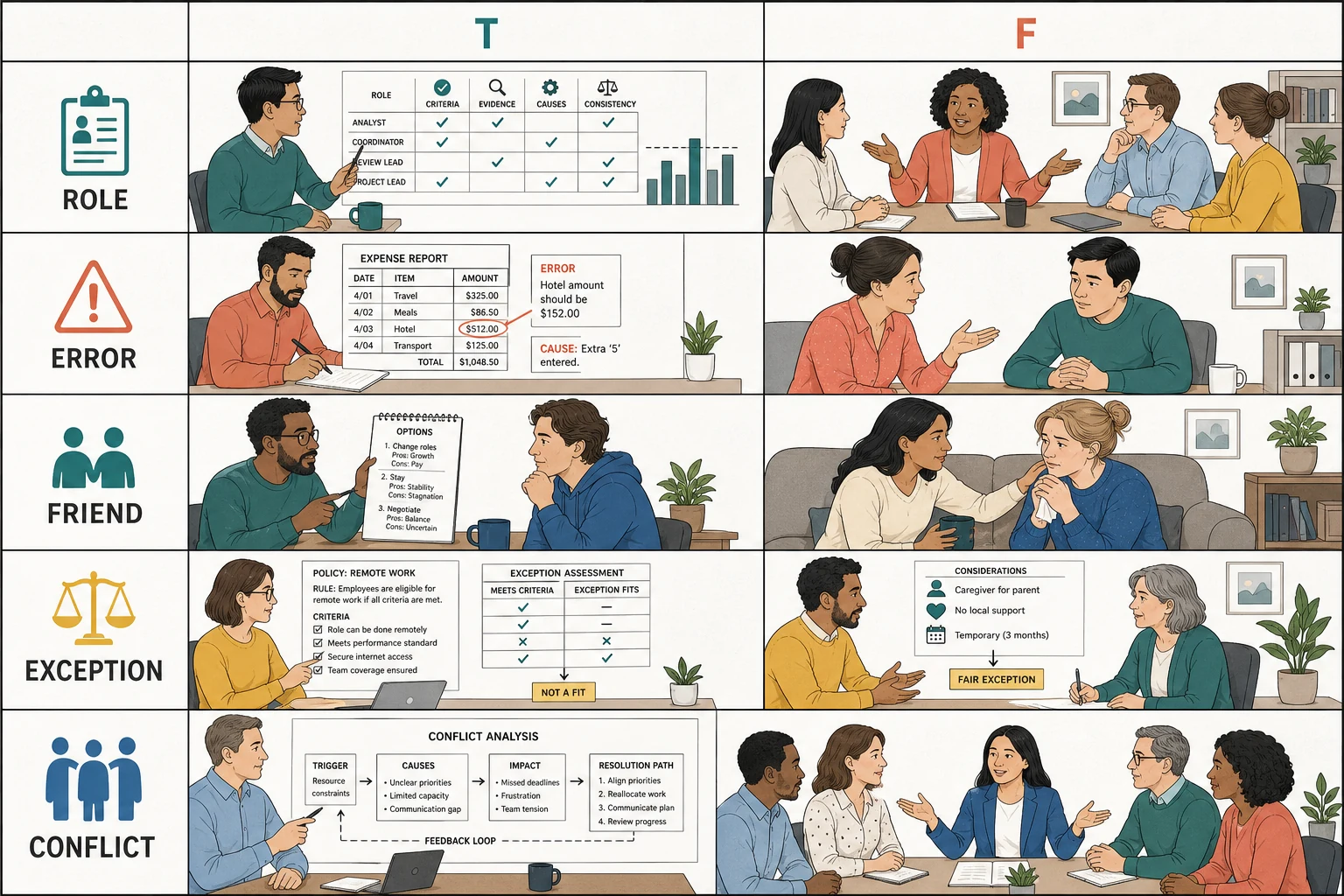
MBTI Thinking (T) and Feeling (F) do not mean logical versus emotional. Both sides use logic, have feelings, care about people, and can make hard decisions. The difference is which question usually comes first. In a role change, T may first compare responsibilities and evidence while F first asks how the move affects the people involved. To correct an error, T may name the mismatch directly while F may first choose wording the person can hear. When a friend is upset, T may offer a fix while F first shows understanding. For an exception, T may test whether the same rule could be defended in similar cases while F may ask whether strict application is fair here. In team conflict, T often maps facts and causes first; F often repairs enough trust for the discussion to continue.
Neither opening is complete by itself. T improves a decision by adding the human cost and delivery. F improves it by stating the rule, evidence, and concrete conclusion. The final answer may be identical: both can approve the transfer, point out the error, advise the friend, refuse the exception, or remove someone from a team.
Do not identify T or F from the final answer to one decision. Watch the first question across several decisions. Two people may both refuse an exception: T because the rule cannot be defended consistently for others, F because the exception would shift an unfair cost onto another group. The answer is the same; the consideration named first differs. Three to five real decisions tell you more than asking whether you are “rational.”
This difference gets distorted almost immediately in everyday MBTI conversation. Feeling becomes "too emotional." Thinking becomes "cold but objective." Both are bad summaries. They flatten two legitimate decision-making routes into a moral ranking. If you want the broader four-dimension framework first, go to MBTI Four Dimensions Explained — A Complete Deep Dive or MBTI Four Dimensions Explained — A Complete Deep Dive.
T and F differ in what they check first
Thinking types usually ask questions like these first: does this make sense, is it consistent, what standard applies, what outcome does this structure produce, where is the logical weakness. Their attention naturally goes toward coherence and external criteria.
Feeling types usually ask a different first set of questions: what does this do to the people involved, is it fair, does it violate an important value, can I actually stand behind this choice, what kind of relationship consequence does this create. Their attention naturally goes toward human meaning and ethical fit.
Both groups are evaluating. Both groups are capable of analysis. The important distinction is sequence. Thinking types often move from structure toward people. Feeling types often move from people toward structure. Many recurring misunderstandings disappear once that sequencing difference is named clearly.
Feeling Does Not Mean Emotional Impulsiveness
This is the single most important correction. Emotional impulsiveness is about being swept away by immediate affect without a stable framework. Feeling preference is something else. It is a preference for treating values, fairness, relational impact, and human consequence as essential variables in the judgment itself.
A Feeling-oriented manager handling layoffs, conflict, feedback, or role changes may take longer because they are evaluating more than procedural efficiency. They are also evaluating dignity, trust impact, emotional cost, and whether the decision can be defended ethically. That is not lower reasoning. It is a broader decision frame.
Many Feeling types are actually highly consistent once you understand what their consistency is anchored to. They may be slower to close a decision than some Thinking types, but that often reflects serious values-based filtering rather than indecision.
Thinking Does Not Mean Lack of Care
The opposite stereotype is just as misleading. Many Thinking types care deeply about people. What differs is their default support style. When someone brings a problem, Thinking types often move first toward analysis, diagnosis, sequencing, and solution design. They may assume that the most respectful and useful thing they can do is help clarify reality.
To someone who needs emotional acknowledgment before solutioning, this can feel sharp, distant, or even invalidating. But the underlying problem is often not absence of care. It is difference in order. The Thinking type is starting where they believe help becomes practical.
Mature Thinking types often learn to widen the entrance. They still use structure, but they precede or accompany it with recognition of emotional reality. That does not make them less Thinking-oriented. It makes them better translators.
Why T/F Differences Show Up So Strongly in Feedback
Feedback is one of the easiest places to observe the T/F divide. Thinking types often prioritize clarity over cushioning. If the logic is weak, the execution is flawed, or the standard is not being met, they may say that quickly and directly. From their perspective, this is efficient, honest, and useful.
Feeling types often prioritize receptivity along with accuracy. They want the other person to remain able to hear the message, so they naturally pay more attention to delivery, context, tone, and whether the relationship can absorb the feedback without unnecessary damage.
This is where the mutual frustration begins. Thinking types may feel that Feeling types take too long to get to the point. Feeling types may feel that Thinking types introduce preventable defensiveness by treating a human exchange as a purely technical correction. Neither side is trying to fail. Each side is minimizing a different kind of loss: information loss versus relational loss.
Conflict Reveals the Difference Even More Clearly
In conflict, Thinking types often want to clarify sequence, causality, responsibility, and principle. What happened, what rule was violated, what assumption was wrong, and how do we prevent this next time. For them, restored order comes through analysis.
Feeling types often want to address relational rupture at the same time. They may find it difficult to move into clean analysis if the emotional field still feels damaged, dismissive, or unsafe. For them, restored order includes restored human understanding.
This is why many T/F conflicts feel circular. The Thinking person believes the issue is being avoided in favor of emotional atmosphere. The Feeling person believes the issue cannot be resolved properly because the emotional meaning of what happened is being ignored. Both are trying to resolve the conflict, but not through the same doorway.
Strong Collaboration Requires Translation, Not Conversion
Healthy T/F collaboration does not require a Thinking type to become a Feeling type, or vice versa. It requires each person to add one step beyond their natural default. Thinking types often need to acknowledge emotional and relational reality before moving into structure. Feeling types often need to make their standards and actual conclusions more explicit instead of leaving them inside atmosphere and implication.
That is not self-betrayal. It is translation. You keep your own orientation while recognizing that the other person enters the problem from a different side. This matters especially in leadership. Teams rarely consist entirely of one orientation, and a leader who only uses one decision language will reliably alienate the people who need the other one.
A very practical question helps here: when this other person feels hard to work with, are they actually rejecting the facts, or are they simply not entering the issue in the order I prefer? Asking that question often reduces unnecessary friction faster than any stereotype about who is more rational.
Four Persistent Misreadings
Misreading one: Feeling types belong in people roles and Thinking types belong in technical or strategic roles. Real life is far less neat. Preference affects style, not capability ceiling. Mature Feeling types can make hard strategic calls. Mature Thinking types can manage people extremely well.
Misreading two: Thinking is more objective. Everyone has subjectivity. Thinking types often hide their values inside apparently neutral standards, but the choice of standard itself usually contains a value judgment. Recognizing that can make Thinking judgments stronger, not weaker.
Misreading three: Feeling types are easier. Many Feeling types do care deeply about harmony, but that does not mean endless flexibility. When an important value is violated, Feeling types can become extremely firm.
Misreading four: Knowing whether someone is T or F solves the communication problem by itself. It does not. Type gives you a translation framework, not a complete map. Trust, history, power, timing, and context still matter.
How to Tell Which Side You Lean Toward
The most reliable method is not asking whether you are logical. It is reviewing real decisions. When you have to refuse a request, what appears first in your mind: consistency, fairness to the system, boundary clarity, and efficiency; or the other person's likely experience, dignity, and relational consequence? When someone brings you a painful situation, do you instinctively want to clarify the structure of the problem, or do you first want them to feel understood?
If the answer trends clearly in one direction across many contexts, that is usually your natural entry point. The useful goal is not to moralize the result. The useful goal is to understand where your default helps, where it costs you, and how to widen your range without pretending to be a different kind of person.
If you want the next step, go back to the whole four-dimension framework and look at how T/F combines with the other three preferences. MBTI Four Dimensions Explained — A Complete Deep Dive is the better reading-path guide, while MBTI Four Dimensions Explained — A Complete Deep Dive is the broader systems overview. The point of understanding T/F is not to prove who is better. It is to prevent avoidable misunderstandings that come from confusing different judgment routes with different levels of humanity.
Three scenes with the missing step added
Case 1: A strong employee asks for a role change
The T-preference manager compares performance evidence, the new role's requirements, and the rule used for other candidates. The F-preference manager asks what the employee values, how the current team will absorb the move, and whether the process feels honest. A complete decision publishes the criteria, listens to the person's reasons, tests team impact, and gives a clear answer with a date.
Case 2: A friend keeps repeating the same problem
The T opening is, “Here are the two actions that would change this.” The F opening is, “That sounds exhausting; do you want advice or do you want me to listen?” The T friend can add one sentence of recognition before problem-solving. The F friend can ask what concrete help is wanted rather than assuming emotional support is enough. These additions are communication skills, not a change of type.
Case 3: Two teammates blame each other
T helps reconstruct what was agreed, where information failed, and what process should change. F helps each person state the impact without humiliation and checks whether they can still work together. The repair needs both: a shared account of events, acknowledgment of harm, named responsibilities, and a next action. Type cannot excuse insults, retaliation, or refusing accountability.
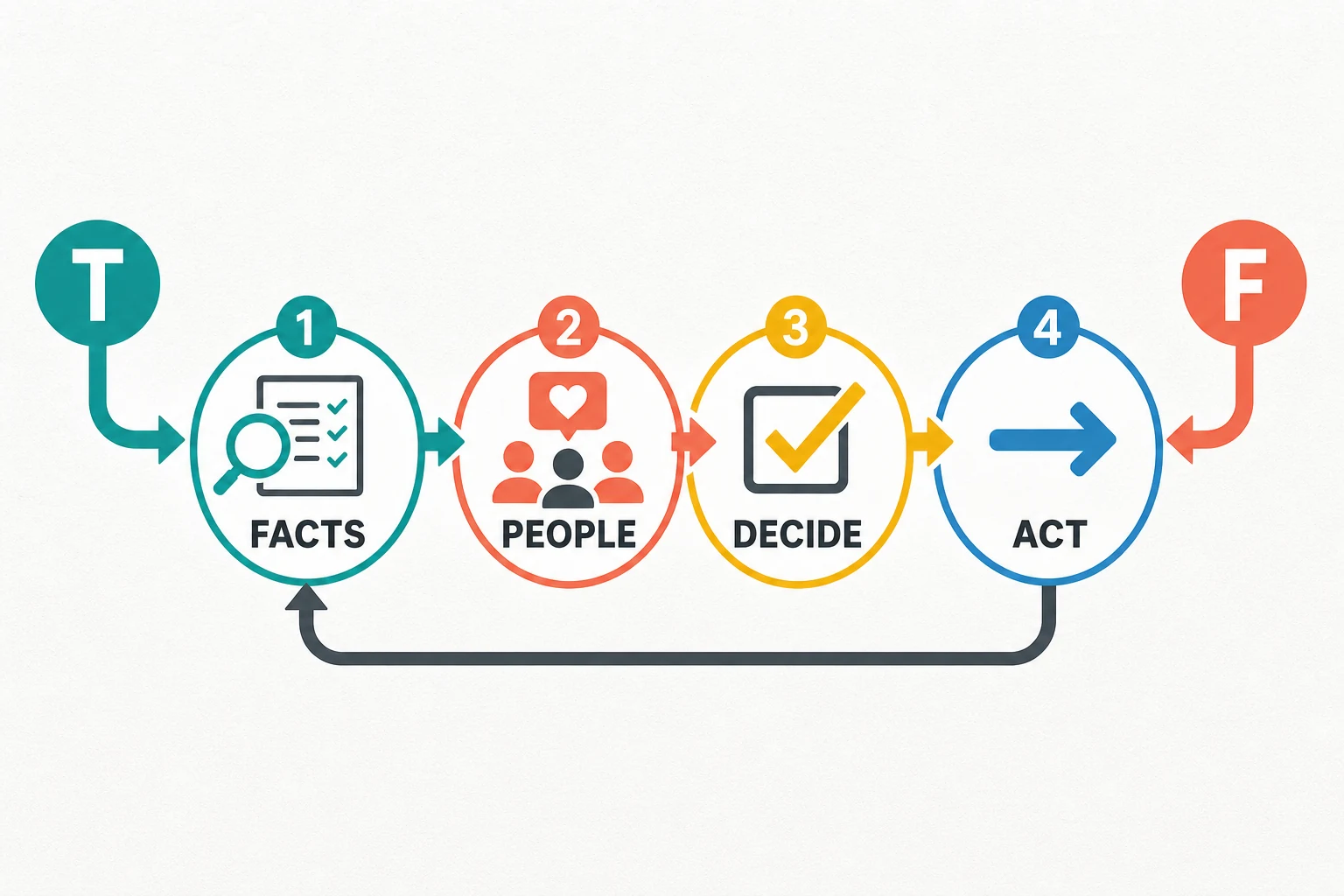
The official Thinking or Feeling preference page describes the contrast in decision emphasis, while MBTI basics states that people can use both sides. Use those definitions as anchors, then check several real decisions rather than typing yourself from one argument.
MBTI thinking vs feeling: next reading check
Use this section when your real question is close to MBTI thinking vs feeling, MBTI T F difference, thinking type feeling type, MBTI dimensions. The useful move is to connect the page to one concrete observation, one adjacent type or letter question, and one next page instead of reading another broad personality summary.
For a wider reading path, pair this page with the type library, the MBTI reading roadmap, and where to read your result deeply.
Related reading
What to Read After 16Personalities If You Want a Deeper MBTI Explanation
What to read after 16Personalities if you want a deeper MBTI explanation instead of stopping at the first result page.What does J/P really mean in MBTI? It is not just organized versus messy
A direct-answer page about the real meaning of J/P, common misunderstandings, and how to judge the dimension in real life.How to Check an INTJ MBTI Result Before You Accept the Label
A complete INTJ test and result check using four letters, real scenes, nearby types, and a seven-day observation log.Keep exploring
Take the test to see your type, or browse more MBTI guides and answered questions.