
Contextual article
How to Check an INTJ MBTI Result Before You Accept the Label
19 min read
· By itypelab Editorial Team
· 2026-07-10
· Updated 2026-07-31
A complete INTJ test and result check using four letters, real scenes, nearby types, and a seven-day observation log.
Best for readers who already know MBTI and want to connect it to real work, relationships, or self-observation.
This article breaks a common MBTI topic into more usable signals instead of stopping at a quick answer.
You'll leave with a clearer interpretation frame and a better sense of whether to continue into a type page, question page, or guide.
If you have not tested yet, take a complete personality test rather than a short quiz that asks whether you match INTJ stereotypes. If you already received INTJ, check all four letters: Introversion means reflection tends to come before external exchange; Intuition means patterns and implications tend to appear before a full inventory of details; Thinking means consistent principles and causes tend to enter decisions early; Judging means an external plan or decision tends to feel better once it is settled.
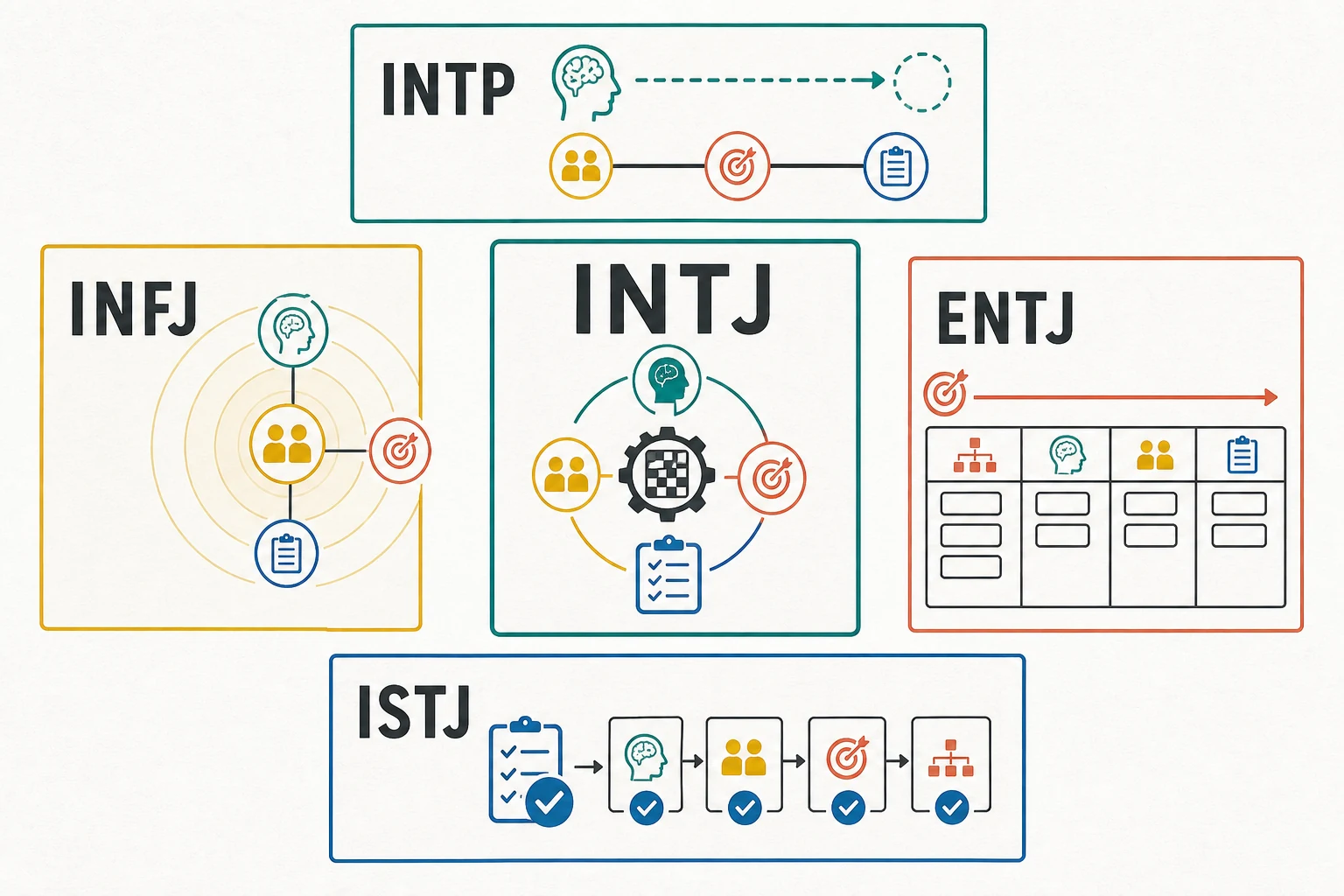
Then look for ordinary behavior: thinking before a meeting contribution, asking what system disconnected tasks are supposed to build, testing whether a plan will still make sense in six months, and turning an unclear project into milestones and owners. Compare the result with INTP (keeps analysis open longer), INFJ (puts people and values nearer the center of the model), ENTJ (organizes the external plan sooner), and ISTJ (leans more on proven detail and procedure). This is more useful than asking whether you are strategic, private, or intelligent.
If the result page shows percentages or bars, identify the letter closest to the midpoint: compare ENTJ when I/E is close, ISTJ when N/S is close, INFJ when T/F is close, and INTP when J/P is close. A percentage is not “how much INTJ” you are. It only shows which side this set of answers favored on that dimension, so a close letter should be checked against real situations.

For a full type profile, read INTJ Personality Deep Dive or INTJ. This page is narrower. It is for the moment right after a test result, when you need to decide whether INTJ is the right next page or only one possible reading path.
First Check: What Did the Test Actually Show?
Start with the chart if the test gives one. Was INTJ supported by four clear dimensions, or did one letter barely win? A strong N/T/J pattern with a close I/E result is different from a result where all four letters are near the middle. The first case may mean "read INTJ, then compare." The second may mean "read the close dimensions before trusting the type."
This step prevents a common mistake: using INTJ as a mood. Words like strategic, independent, analytical, and future-focused can feel accurate to many people. The result becomes more useful only when you connect those words to repeated behavior.
Look for the Planning Pattern, Not Just Ambition
INTJ is often flattened into "ambitious planner." That is too broad. A better check is whether you naturally build an internal model before you move. In a project meeting, an INTJ-like pattern may show up as quiet impatience with disconnected tactics. The person is not only asking, "What is the next task?" They are asking, "What system are these tasks supposed to create?"
That is different from simply liking goals. Many types like goals. The INTJ question is usually about whether the plan coheres, whether the assumptions hold, and whether the current move still fits the long-range model.
Check How You Respond to Inefficient Systems
A useful INTJ result often shows itself when a system wastes effort. Imagine a team keeps solving the same support problem manually. An INTJ-pattern reader may quickly start redesigning the process: remove duplicated steps, change the routing rule, write the prevention checklist, or rebuild the decision logic.
That does not mean every INTJ is organized in every part of life. It means the mind often notices structural waste and wants a cleaner model. If your result says INTJ but your real frustration is mostly about social overload, emotional mismatch, or open-ended options, you may need nearby-type reading before settling.
Compare INTJ With Nearby Possibilities
Do not validate INTJ in isolation. Compare it against the types that commonly feel close.
| If this also fits | Check this difference |
|---|---|
| INTP | Do you want the model closed into a strategy, or kept open for analysis? |
| INFJ | Is relational impact central to the model, or secondary to system logic? |
| ENTJ | Do you primarily build the model inwardly first, or organize the external plan quickly? |
| ISTJ | Is the pattern future-system oriented, or anchored in proven procedure and detail? |
The point is not to overcomplicate the result. It is to keep a plausible label from becoming too sticky too fast.
Watch the Stress Version
Stress can make an INTJ result both clearer and more confusing. Under pressure, an INTJ-like person may become sharper, more impatient with inefficiency, and less willing to explain every step. But stress can also make other types look more rigid or detached. If you tested during burnout, conflict, or heavy deadline pressure, the INTJ label may be partly reading your narrowed state.
So ask for calmer evidence. What patterns show up when there is no crisis? Do you still build models, test assumptions, and prefer strategic coherence? Or did the test mainly capture a stressed version of control?
A Practical INTJ Result Audit
Use these questions before accepting the label:
1. Do I form an internal model before I explain my plan? 2. Do disconnected tactics bother me more than slow discussion itself? 3. Do I test ideas by whether the logic will hold over time? 4. Do I become more compressed and final under pressure? 5. Which nearby type explains the same scenes almost as well?
If the answers keep pointing to model-building, strategic coherence, and long-range logic, INTJ is worth reading deeply. If the answers scatter across different motives, keep the result open.
Next Reading
Three result-check scenes
Case 1: A meeting starts without an agenda
You stay quiet for the first minutes, not because you have no opinion, but because you are trying to understand what decision the group is actually making. Once that structure is clear, you offer a compact proposal. This supports I and possibly N/J, but it is not enough alone. A shy Extravert or an experienced ISTJ could also wait. Check whether private model-building repeats in familiar meetings where anxiety is low.
Case 2: A new product has too many possible features
You do not simply generate more ideas. You ask which few assumptions determine the product’s future, remove features that do not serve that direction, and turn the remaining route into a sequence. That combination is more INTJ-like than idea generation alone. An INTP may want to keep testing the model before committing; an ENTJ may start assigning owners while the model is still forming.
Case 3: Feedback challenges your plan
Your first reaction is to test whether the new evidence changes the underlying assumptions. If it does, you revise the plan even if you dislike the interruption. If it does not, you ask for a clearer argument. This is better evidence than simply disliking criticism. Defensiveness appears in every type; the useful question is what happens after the initial feeling.
A seven-day INTJ log
For seven days, record one planning, decision, or conflict moment. Write four short lines: what happened; what you noticed first; what you did next; and which nearby type could explain the same move. Include one counterexample, such as a day when you talked to think, relied on proven procedure, centered a relationship need, or kept options open.
Use official definitions as anchors: the Foundation’s MBTI basics explains the four preferences, while MBTIonline provides an INTJ type overview. Neither source can confirm your individual type from a paragraph. A complete test, several ordinary scenes, and a nearby-type comparison together provide a more defensible reading.
Read INTJ Personality Deep Dive for the broad pattern. If the issue is INTJ vs INTP, use INTP vs INTJ. If INTJ and INFJ both feel plausible, read INFJ vs INTJ. If the result chart itself was close, start with How to Read an MBTI Result When Two Dimensions Are Very Close.
An INTJ result is useful when it improves observation. It is less useful when it becomes a prestige label or a reason to stop comparing.
Related reading
What to Read After 16Personalities If You Want a Deeper MBTI Explanation
What to read after 16Personalities if you want a deeper MBTI explanation instead of stopping at the first result page.Is MBTI accurate? What it can help with, and what it should not replace
A question page about MBTI accuracy, usefulness, and limitations.INTP Logician: Traits, Nickname Meaning, and Nearby Types
Start with the main INTP traits and Logician nickname, then separate analytical preference from intelligence and nearby types.Keep exploring
Take the test to see your type, or browse more MBTI guides and answered questions.