
Contextual article
Can a Cognitive Functions Test Confirm Your MBTI? Read the Scores, Not Just the Suggested Type
26 min read
· By itypelab Editorial Team
· 2026-07-20
Separate answers, function scores, and the provider's type conversion, then test one specific nearby-type question against repeated behavior.
Best for readers who already know MBTI and want to connect it to real work, relationships, or self-observation.
This article breaks a common MBTI topic into more usable signals instead of stopping at a quick answer.
You'll leave with a clearer interpretation frame and a better sense of whether to continue into a type page, question page, or guide.
A cognitive-functions test can narrow a candidate set, but it cannot confirm your MBTI by itself. It works best on one specific question such as “INFJ or INTJ?” If you read only the four-letter recommendation at the top, you skip the strongest available evidence: what the items asked, how far apart the eight scores are, which functions are effectively tied, and whether those contrasts predict repeated behavior outside the test.
If E/I, S/N, T/F, and J/P are all still moving, an eight-function profile usually multiplies the uncertainty. Start with what the four letters mean, then use functions to resolve one remaining ambiguity. Functions are a higher-resolution lens, not an identity certificate.
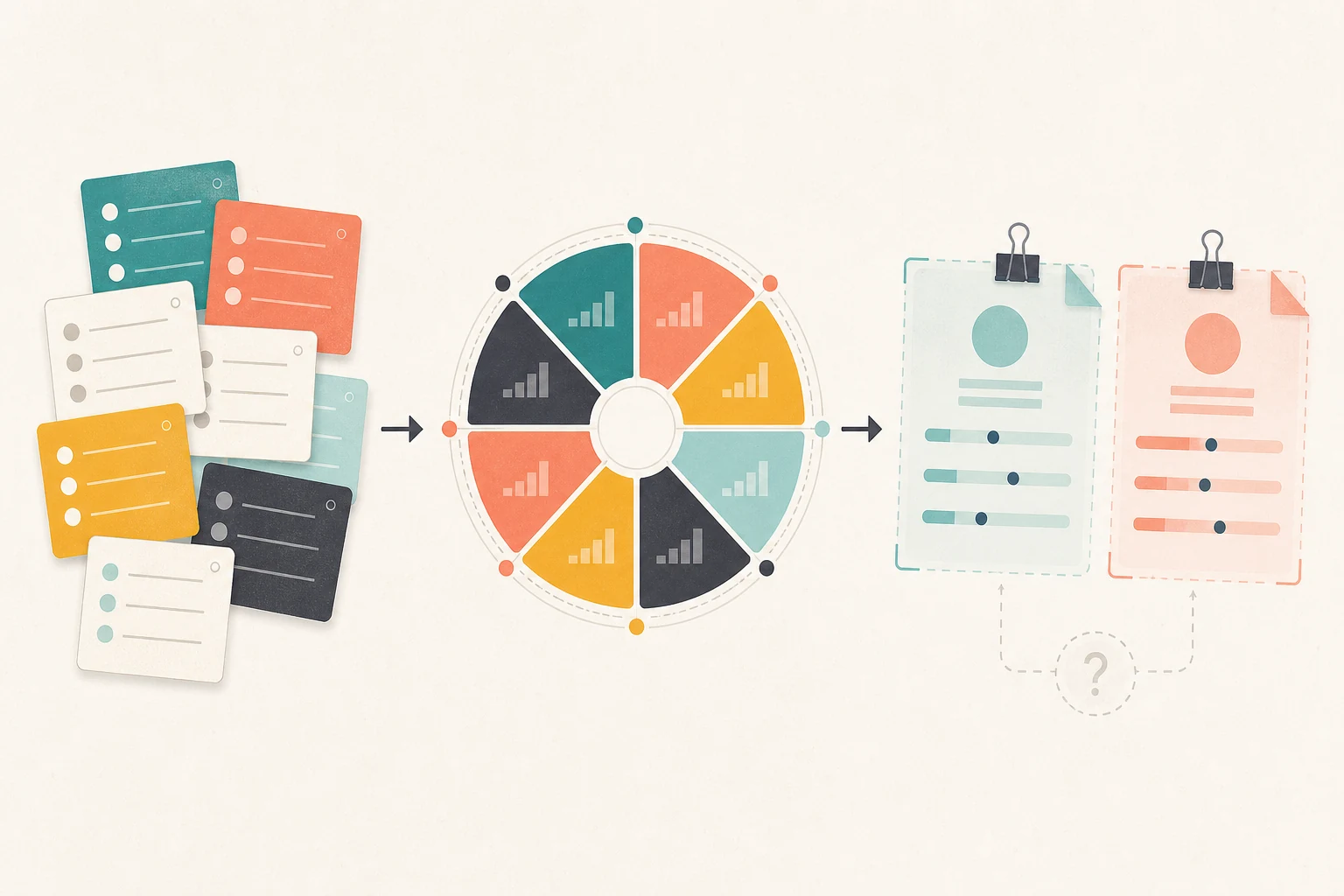
Separate the three outputs that result pages often blend together
Online “cognitive-functions tests” are not one standardized product. A result page may combine three different outputs and present them as one answer.
| Output layer | What you may see | What it can answer | Common overclaim |
|---|---|---|---|
| Raw or standardized score | Ni 37, Ne 31, Fe 34 | How strongly you endorsed this site's item group | Ni 37 has the same meaning on every site |
| Relative order | Ni > Fe > Ne > Ti | Which item groups stood out in this session | The highest score must be the dominant function |
| Type conversion | INFJ, ENFJ, INTJ candidates | How the site maps its scores to a type model | The first recommendation is a confirmed true type |
The first layer is closest to what you supplied. The third contains the most assumptions from the test designer. Sites can differ in items, weighting, expected-stack bonuses, and conversion rules, so conflicting recommendations are not surprising.
The Myers & Briggs Foundation's Type Dynamics overview describes how preferences interact in a processing sequence. Independent online tests try to estimate those processes with their own questionnaires. The ideas are related, but that does not make every online function test equivalent to the official MBTI assessment.
A worked function-score audit
Assume Maya receives the following profile. The figures are fictional and do not represent a universal scale used by any provider.
| Function | Mock score | First-round interpretation | What it does not establish |
|---|---|---|---|
| Ni | 37 | Strong endorsement of converging-pattern items | Proven Ni dominance |
| Fe | 34 | Relational effect enters many judgments | Guaranteed empathy or an F type |
| Ne | 31 | Alternative-generation items also fit | ENFP or ENTP by necessity |
| Ti | 29 | Internal-consistency checking is visible | Ti is definitely tertiary |
| Fi | 25 | Personal-value items fit less strongly here | Weak values or inauthenticity |
| Si | 22 | Experience-reference items fit less often | Poor memory |
| Te | 20 | External-organization items fit less often | Inability to plan or deliver |
| Se | 18 | Immediate-response items fit less often | Poor athletic or practical ability |
The first observation is that Ni, Fe, Ne, and Ti are all substantial. They do not form a perfectly clean stack. The useful question is not whether 37 is “high enough for INFJ.” It is why Ne is also high. Did the questionnaire treat general curiosity as Ne? Is Maya doing highly generative work this month? When no role demands exploration, does she keep opening interpretations or converge quickly on one?
Case one: INFJ versus INTJ requires a decision-order test
Maya pays close attention to whether interview questions embarrass users, which can lift Fe-like responses. When writing findings, she removes claims unsupported by evidence, which can look like Te or Ti. “Warm and analytical” does not separate INFJ from INTJ.
Put both hypotheses into one conflict. Evidence supports removing a feature, but long-term customers will feel a promise has been broken. Maya first maps the relational commitment and then searches for an evidence-consistent way to communicate the decision. She does not reach an efficiency conclusion first and add stakeholder messaging afterward. That repeated order supports the INFJ hypothesis more than the raw Fe score does. If she consistently establishes an executable standard first and treats relational effects as implementation constraints, INTJ remains stronger.
The result is still a hypothesis, not confirmation. What improved is the prediction: the two types now imply different first moves in the same scene.
Case two: ENFP versus ENTP cannot be settled by high Ne
Alex receives Ne as the top score and both ENFP and ENTP as recommendations. Alex generates ideas quickly, enjoys debate, and cares about friends. Broad descriptions of either type fit.
A campaign creates a sharper contrast. It will perform well, but the message is arguably misleading. If Alex continues to reject it after the logic and performance case are repaired because “this conflicts with what I am willing to stand for,” personal valuation may close exploration. If the main objection remains equivocation, inconsistent definitions, or a model that cannot survive scrutiny, internal logical coherence may be doing more of the closing work.
Both people can care about users and use logic. The distinction is what finally ends option generation. The test contributed Ne as a shared starting point; the case compares Fi and Ti where they produce different consequences.
Case three: a project manager's Te score may reflect trained responsibility
An INFP project manager maintains schedules, chases risk owners, and asks for dates every day. Te items score high, and the site recommends ENTJ. Yet outside accountable delivery, this person does not organize everyone or choose by efficiency. The visible behavior is partly the cost of holding a role that cannot drift.
Compare three low-obligation scenes: personal travel without dependents, a friend's values conflict, and a weekend plan disrupted at the last moment. Does external structuring appear automatically? Is the first concern loss of control, or a violated commitment and loss of meaning? If Te rises mainly when responsibility and consequences are explicit, it is strong learned equipment but weak evidence for replacing the original type hypothesis.
A five-step method for turning scores into evidence

Do not open three more test sites yet. Work through the current result first.
1. Find the scale and scoring explanation. If the range, reverse items, or conversion are undocumented, compare only relative positions within that page. 2. Mark practical ties. A one- or two-point difference rarely deserves a full hierarchy. Treat close scores as a candidate group. 3. Identify role contamination. List behaviors imposed by work, caregiving, exams, burnout, or a current relationship crisis. 4. Keep only two competing explanations. Each must predict a different first move in the same scene. If they predict nothing different, they are not yet useful candidates. 5. Actively seek disconfirming evidence. Write one recurring behavior that would weaken each candidate instead of collecting only flattering matches.
| Result pattern | Useful next move | Avoid |
|---|---|---|
| One high function with a messy surrounding order | Review whether interest or role demands inflate those items | Declaring a dominant function immediately |
| Two candidates differing by one letter | Run a same-scene nearby-type comparison | Reading two more broad profiles |
| Eight scores tightly clustered | Return to dimensions and ordinary-life samples | Building a stack from tiny differences |
| Every platform gives a new type | Compare items and conversion rules | Testing until a preferred identity wins |
| The result requires dismissing normal behavior | Suspend the result and audit the answering state | Explaining away reality to protect theory |
Use the nearby-type comparison method when two candidates remain. If several dimensions are close, read close MBTI dimensions first. More technical vocabulary is not a reason to skip foundational checks.
Compare test sites by transparency, not by an accuracy leaderboard

Sakinorva, Michael Caloz, IDRlabs, and other provider names appear in autocomplete queries. Search frequency is not validation evidence. A more defensible comparison asks whether the site explains:
- whether it measures four-letter dimensions, self-rated functions, or a mixture;
- whether raw scores remain visible or disappear behind one type code;
- how scores become type recommendations;
- whether tied or uncertain results are allowed to remain uncertain;
- whether items confuse preference with ability, interests, virtue, or maturity;
- whether the report gives boundaries and a useful next step.
The official MBTI basics presents type as a preference framework, not an ability ranking. A test that turns a high function score into greater intelligence, maturity, or talent has crossed that boundary before its type conversion is even considered.
When the test is worth taking, and when to stop
The test is most useful when the four-letter picture is reasonably stable, one nearby pair remains, you are willing to inspect item wording, and you can supply ordinary-life counterexamples. Then the output can sharpen one question.
Stop when every test becomes a new identity, when you answer with memorized function definitions, when “inferior function” becomes an explanation for symptoms or harmful conduct, or when the theory requires denying most of your real behavior. MBTI is not a mental-health diagnosis and does not remove responsibility.
For the conceptual layer, use the cognitive-functions beginner guide. For the post-test sequence, use the result deep-reading checklist. A function test has done useful work when it makes one real-life difference easier to test, not when it gives you a more elaborate label.
Sources and scope
- Myers & Briggs Foundation: Type Dynamics Overview supports the description of official type dynamics as interacting preferences and process order.
- Myers & Briggs Foundation: MBTI Basics supports the preference-framework boundary.
This page does not claim that a third-party function test is equivalent to the official MBTI assessment and does not rank providers by accuracy. The mock scores demonstrate an audit method only and must not be transferred to another site's scale.
Related reading
Best MBTI Type Descriptions: Pick the Right Website by Reading Stage
A decision page for best MBTI type descriptions: match official, overview, or deep-reading sites to your current stage instead of hunting one universal winner.How do I go deeper after learning my MBTI type?
A direct answer for deeper MBTI reading after learning your type.What Does ISTP 4w5 Mean? Two Systems, Not One Subtype
Treat ISTP 4w5 as two hypotheses, not one validated subtype. Compare preferences, motives, skills, context, and disconfirming evidence separately.Keep exploring
Take the test to see your type, or browse more MBTI guides and answered questions.