
Contextual article
What Does ISTP 4w5 Mean? Two Systems, Not One Subtype
22 min read
· By itypelab Editorial Team
· 2026-07-21
· Updated 2026-08-05
Treat ISTP 4w5 as two hypotheses, not one validated subtype. Compare preferences, motives, skills, context, and disconfirming evidence separately.
For readers who relate to ISTP 4w5 but want to know how much the combined label really explains.
Privacy, technical skill, and independence can have many causes. They do not prove that both labels are correct.
Track ISTP and 4w5 separately for four weeks, including what fits and what does not, before deciding how useful each label is.
ISTP 4w5 means two labels from two systems stacked together—not one official MBTI subtype and not two scores from one test. ISTP is an MBTI-style preference code. 4w5 is an Enneagram Type Four with a Five wing. Quiet skill, private creativity, or hands-on problem solving can fit either story without proving both.
The practical split: MBTI asks how someone takes in information and decides. Enneagram descriptions ask why they protect or pursue something. Test the two claims on separate tracks before treating “ISTP 4w5” as a single identity.
| Label | System | What it is trying to describe | What it does not prove |
|---|---|---|---|
| ISTP | MBTI-style preferences | Typical ways of gathering information and deciding | Motive, identity wound, or artistic destiny |
| 4w5 | Enneagram Type 4 with 5 wing | A motive narrative around identity, withdrawal, and knowledge | That the person is also ISTP |
| ISTP 4w5 | A popular stack | Two hypotheses side by side | A researched combined subtype |

Page deliverables
- A simple table showing why “what someone did” and “why they did it” are different questions.
- A four-week log that tracks ISTP and 4w5 separately, including what fits and what does not.
- Four scoring questions that go beyond “this description sounds like me.”
The same behavior can have different reasons
| What you see | What else you need to know | Do not assume |
|---|---|---|
| Likes to take things apart while learning | Does this happen in other kinds of learning too? | All ISTPs are mechanics |
| Does not show unfinished work | Is the person afraid of judgment, still refining it, or required to keep it private? | This proves 4w5 |
| Repairs equipment quickly | What training and practice did they have? | Technical skill proves type |
| Leaves a conflict for two days | Were they angry, tired, afraid, or simply trying to cool down? | One withdrawal reveals a permanent motive |
The Myers & Briggs Foundation provides the MBTI side of this distinction. The Enneagram Institute's Type Four and Type Five pages describe those types within the Enneagram tradition. Those commercial descriptions explain terminology; they do not establish that an ISTP 4w5 combination is a researched category.
A systematic review of Enneagram research reports mixed evidence and methodological limitations across the literature. The responsible conclusion is not that no one finds the model useful. It is that personal recognition should not be upgraded into stronger measurement claims than the evidence supports.
Why two labels together can feel unusually accurate
Two broad descriptions can overlap around independence, privacy, observation, self-sufficiency, or unconventional interests. Combining them adds detail, and detail feels like accuracy. But some detail comes from selecting only the parts that fit and supplying personal examples after reading the description.
You do not need to reject both labels. For every example that fits, find one that does not. Then ask whether training, work, culture, current stress, or one particular relationship already explains the behavior.
Case 1: The product engineer who needs hands-on evidence
Owen is a product engineer who distrusts abstract debate until he can inspect a prototype. He changes his mind quickly when the mechanism behaves differently from the model. He also keeps a private notebook of unusual interface ideas and dislikes showing early work.
An ISTP reading can focus on learning through concrete interaction and impersonal troubleshooting. A 4w5 reading may focus on preserving originality and protecting unfinished inner work. Both stories can fit without being the same claim.
Now add disconfirming evidence. Owen enjoys standardized repair tasks and happily adopts another engineer's design when it works better. He does not experience every copied convention as a threat to identity. The originality story fits some creative work, not his entire decision process.
The practical conclusion is modest: prototype access improves his reasoning, and early creative work needs a defined private phase. No combined type is required to negotiate those conditions.
Case 2: The artist who repairs her own equipment
Leila creates sound installations and repairs cables, controllers, and old speakers herself. Online descriptions make “artist plus technician” sound like proof of ISTP 4w5. But the life history matters. She learned repair because equipment was expensive and local support was unavailable. Her artistic practice grew in a community where technical self-reliance was expected.
Ask separate questions. Does Leila consistently prefer direct interaction with materials when learning? That may support an MBTI hypothesis. Does she describe her central struggle in terms of identity, deficiency, withdrawal, or conserving knowledge? That would be relevant to an Enneagram narrative, but only she can report the motive and it may change by context.
The visible combination of art and repair is evidence of skill and environment first. It should not be reverse-engineered into a guaranteed personality code.
Case 3: Withdrawal during conflict has several possible motives
Daniel stops replying after a friend criticizes his work in a group chat. He spends two days alone, returns with a precise explanation, and refuses to discuss the emotional tone. One story says ISTP detachment; another says 4w5 withdrawal to protect identity.
Other explanations remain live. Daniel may be angry about public criticism, worried that a fast reply will escalate, ashamed of an error, or simply exhausted. The way to learn more is to compare conflicts. Does he withdraw after criticism of competence but not after disagreement about plans? Does private feedback produce a different response? What does he say he was protecting?
The repair request can be concrete regardless of type: “If you need time, send one line saying when you will return. I will raise work criticism privately unless there is an urgent group risk.” A useful agreement does not wait for the perfect motive label.
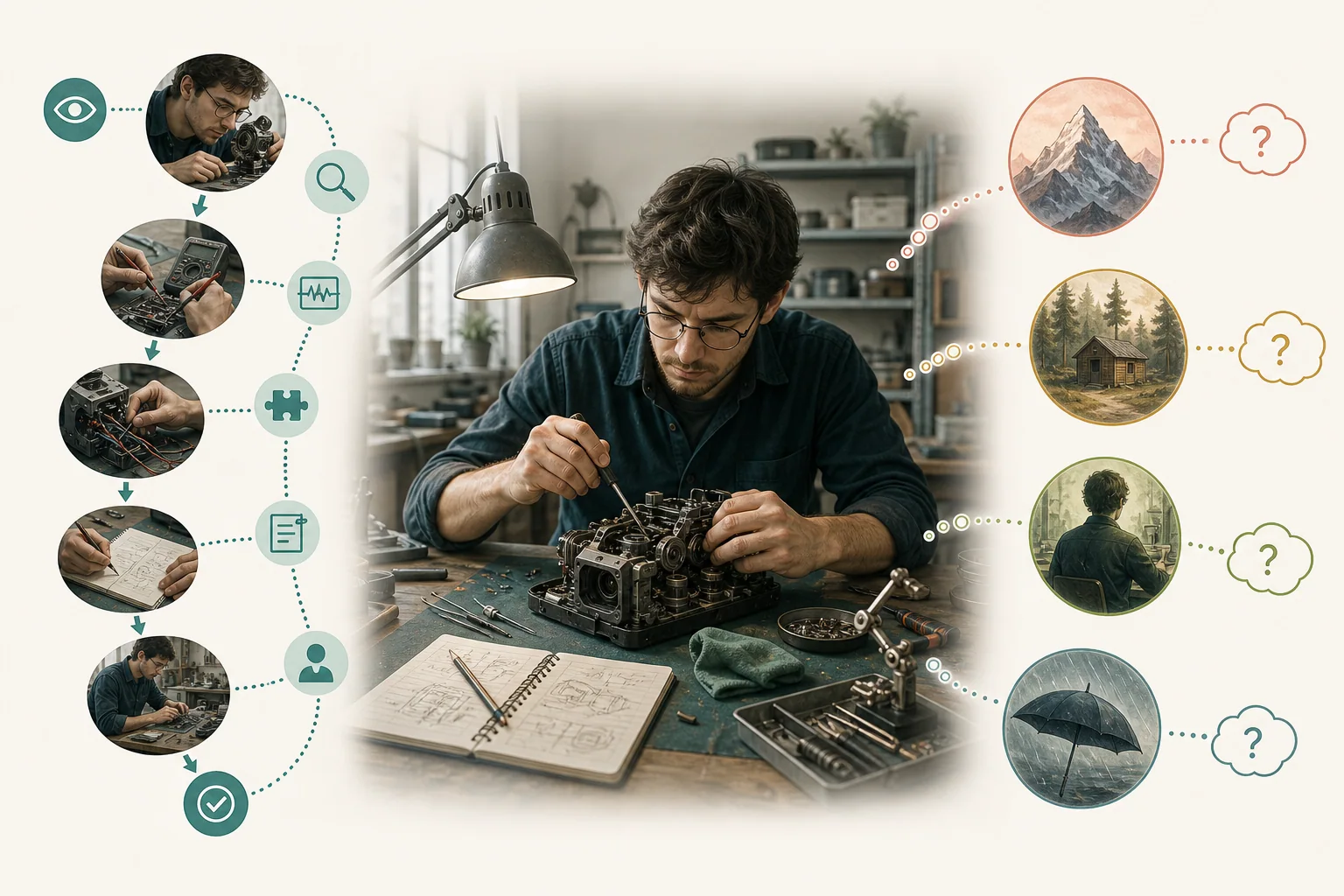
Track the two labels separately for four weeks
Use separate columns for four weeks. Do not write “ISTP 4w5 behavior.” Record the scene first.
| What happened | Possible ISTP reading | Possible 4w5 reading | Another ordinary reason | What did not fit |
|---|---|---|---|---|
| Learned a tool by taking it apart | Concrete interaction supports understanding | Wanted mastery before exposure | Prior repair training | Also learns abstract math well |
| Hid an unfinished project | Preferred private processing | Protected a fragile identity claim | Workplace competition | Shared another draft easily |
| Left a tense conversation | Needed time to analyze | Withdrew to preserve inner resources | Public shame and fatigue | Stayed present in a safer conflict |
After four weeks, ask which column was genuinely useful. Could it predict a new choice? Did you change the conclusion when an example did not fit? If a label can only explain events after they happen, trust it less.
Common mistakes with combined labels
- Turning overlap into validation. Two descriptions fitting together does not validate a new subtype.
- Inferring motive from behavior. Privacy, art, technical work, and withdrawal each have many causes.
- Using rarity as status. A more elaborate code is not evidence of greater depth or intelligence.
- Ignoring measurement differences. Results from informal quizzes may not define constructs or scoring consistently.
- Letting the label excuse repair. Need for space does not remove the duty to communicate boundaries and return where appropriate.
The ISTP type page is the best starting point for the four-letter claim. Use the cognitive functions guide only if you want that additional MBTI interpretation layer; it is not the Enneagram. The deep type-reading guide and same-type variation article help keep context and development visible.
Sources and limits
- The Myers & Briggs Foundation: The 16 MBTI Personality Types supports the MBTI preference framework.
- Hook et al.: The Enneagram, a systematic review supports cautious language about mixed evidence and research limitations.
- The Enneagram Institute Type Four and Type Five pages are used only to represent terminology within that tradition.
The three cases are illustrative. This page does not certify either assessment, diagnose motives, or claim that ISTP 4w5 predicts career, intelligence, creativity, trauma, or relationship outcomes. Treat it as two revisable hypotheses, not a more impressive identity certificate.
Related reading
What Do the Four MBTI Letters Mean in Real Life?
A plain-language guide to what the four MBTI letters mean in real life and how to use them before reading a full type description.What does J/P really mean in MBTI? It is not just organized versus messy
A direct-answer page about the real meaning of J/P, common misunderstandings, and how to judge the dimension in real life.What Is MBTI 64? 16 Types × 4 Subtypes, Not an Official List
Start with the 16 × 4 = 64 calculation, then check source, subdivision rule, scoring method, and practical use before treating a 64-type result as more precise.Keep exploring
Take the test to see your type, or browse more MBTI guides and answered questions.