
Contextual article
MBTI Parenting Styles: Preferences Are Not Parenting Quality
27 min read
· By itypelab Editorial Team
· 2026-08-03
Practical family scenes and repair questions that keep type separate from safety, care, and parenting quality.
Best for readers who already know MBTI and want to connect it to real work, relationships, or self-observation.
This article breaks a common MBTI topic into more usable signals instead of stopping at a quick answer.
You'll leave with a clearer interpretation frame and a better sense of whether to continue into a type page, question page, or guide.
Parenting styles show up first in ordinary moments, not in a personality report. Some parents want to talk as soon as trouble starts. Others calm everyone down before they speak. Some give step-by-step instructions. Others begin with why the task matters. When a child breaks a rule, one parent may start with the consequence while another starts with the child's feelings. Routines differ too: some families keep a fixed schedule, and others adjust as the day changes. These are style differences, not a ranking of who is the better parent.
Through the four MBTI pairs, the pattern is fairly easy to spot. E/I can affect whether a parent talks now or waits. S/N can affect whether they begin with concrete steps or the reason behind them. T/F can affect whether they lead with the rule or with the child's experience. J/P can affect whether the day stays fixed or flexible. Each style can help and each style can fail. Immediate talk can settle a problem or overwhelm a distressed child. Quiet time can restore calm or feel like abandonment. A firm routine can feel safe or rigid. Flexibility can respect change or leave a child unsure what comes next.
So do not start by guessing whether two personalities clash. Look at the small moment in front of you. When a child refuses homework, “Start with question one” is specific, but it may miss that the child cannot understand the instructions. “How would you like to learn this?” sounds respectful, but the work still will not begin without a start time. A more useful line is often: “You need to finish ten questions tonight. Show me the first one that stops making sense. We will work for fifteen minutes and then take a five-minute break.”
The same idea applies when plans change. If rain cancels a promised park trip, new options help, but the child may first need to hear, “You were looking forward to the park, and it makes sense that you are disappointed.” If a child comes home crying after school, ask what happened and whether the child is safe before deciding whether to listen for a while or contact the school. Comfort and problem-solving are not opposites; the order depends on the situation.
Parenting quality is still judged by practical things: whether the child is safe, care is reliable, rules fit the child's age, adults listen, and relationships are repaired after conflict. MBTI cannot explain abuse, severe anxiety, depression, self-harm, or learning difficulties. Those situations call for school, pediatric, or other qualified support, not more guessing about four letters.

Four differences you may notice
E/I can affect whether a parent solves a problem through immediate conversation or gives everyone quiet time first. S/N can affect whether an explanation begins with the next concrete step or the purpose and possibilities. T/F can affect whether discipline begins with a consistent rule or the child's experience and relationship. J/P can affect whether weekends and homework have a set sequence or adapt as the day changes.
Either approach can help or fail. Immediate talk can offer connection or overwhelm a distressed child. Quiet can calm or feel like withdrawal. A firm routine can create security or become rigid. Flexibility can respect changing needs or become unpredictability. The question is what happened, what the child needed, and whether the response worked safely. A parent can also use both sides of a preference; a type description is not a rule about what anyone is capable of doing.
Read the four dimensions for definitions, the relationship guide for wider context, and Thinking versus Feeling for decision differences without moral ranking. These pages can explain a vocabulary; they cannot tell you what a particular child needs tonight.
Three family scenes
Case 1: Homework resistance
A parent sees unfinished work and gives a detailed sequence: open the assignment, complete two questions, take a break, then continue. The child argues because they do not understand the instructions, are hungry, or feel controlled. Another parent might begin with the purpose and choices but never set a start time. Neither “detail” nor “big picture” is enough alone. The first useful question is not “Which preference is showing?” but “What is blocking this child right now?”
Before judging the child, check whether they are hungry or tired, whether the work is too difficult, and what the teacher actually expects. A parent can say, “You need to complete ten questions tonight. Which two do you understand? Show me where it becomes hard. We will work for fifteen minutes, take five, and contact the teacher if the instructions still do not make sense.” This states what must happen while also finding the real problem. If the child still resists, offer a choice: “Math or reading first? Both need to begin by 7:30.”
Avoid turning one hard evening into an identity: “You are lazy,” “You always make everything difficult,” or “You are just a P.” Describe the observable event instead: “The page is open, but we have not started. Is the first step unclear, or do you need five minutes to reset?” A factual question gives the child a way back into the task.
Case 2: A plan changes suddenly
The family promised a park visit, but rain closes it. One parent immediately proposes three alternatives; the child cries because the promised sequence has disappeared. The parent says, “Be flexible,” which adds shame to disappointment. The child may not be refusing every new activity; they may be trying to recover a sense of what happens next.
First acknowledge the disappointment: “You expected the park, and it is closed. It makes sense that you are disappointed.” Then give two clear choices: the library or indoor swimming, with a decision by eleven, and move the park visit to a specific date. Write it down if that helps: “Today: library. Saturday: park if open.” A child often handles change better when they know what will happen next. Safety still comes first, but the adult does not have to dismiss the loss.
Case 3: A child is emotionally overwhelmed
After an argument at school, the child comes home crying. One parent starts solving: report the message, plan tomorrow's conversation, and list what the child should say. The child hears, “Stop feeling and fix it.” Another parent comforts for an hour but avoids discussing repeated bullying. The adult’s urgency may come from love and fear, but urgency is not the same as a safe plan.
Check safety, listen, ask whether the child wants comfort or help making a plan, and then decide what the adult will do next. “Are you safe now? Tell me what happened at your pace. Do you want me to listen, help you plan, or contact the school with you?” If there is a threat, abuse, self-harm risk, or persistent distress, professional help and school safety procedures take priority over type. A parent may need to remind themselves: “I want to fix this immediately, but I can listen for a few minutes first.”
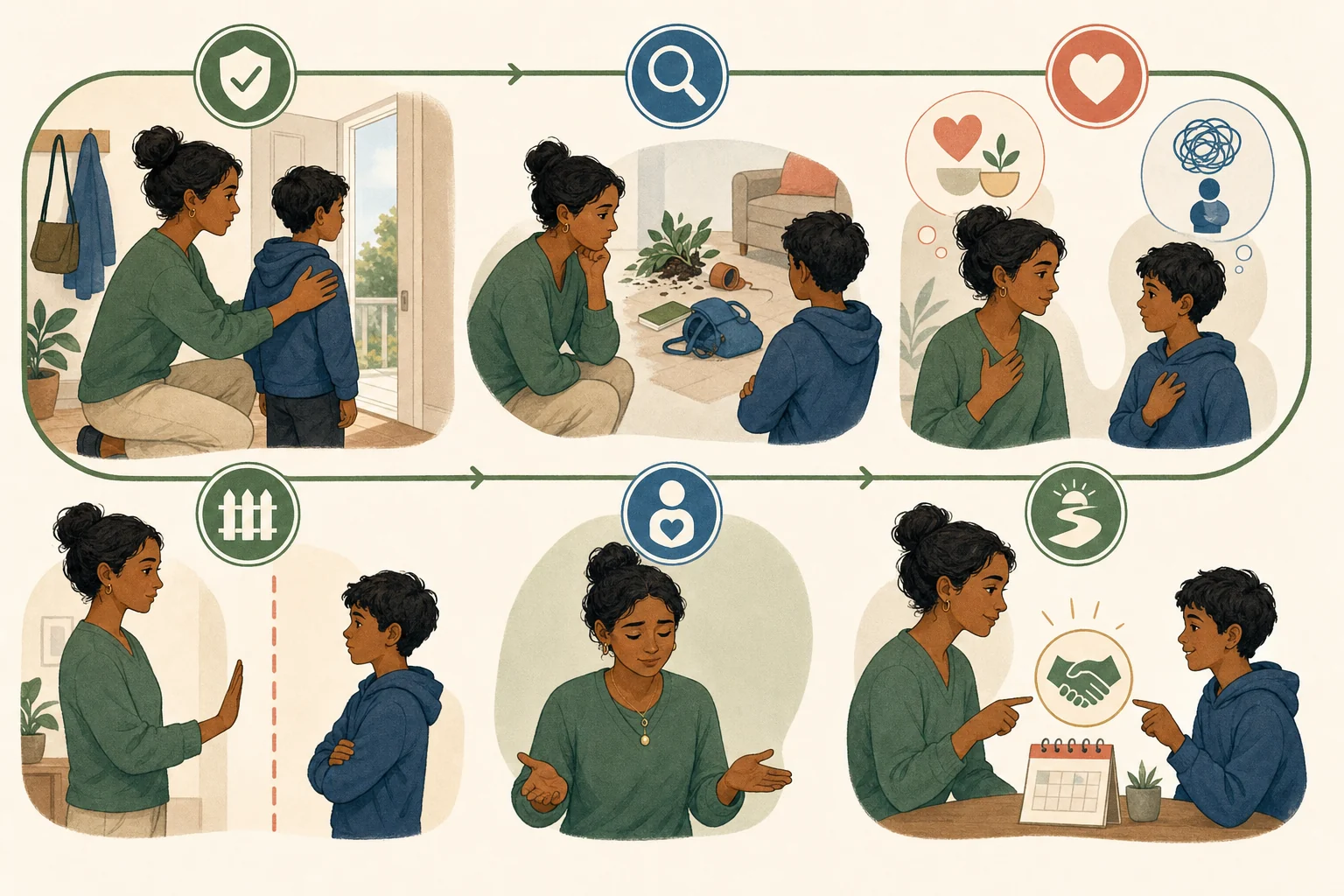
Repair questions after a hard moment
1. What happened, without judging the child's character? 2. Was the child safe, tired, hungry, overloaded, frightened, or confused? 3. What limit still needs to hold? 4. What feeling or need should be acknowledged? 5. What can the parent own: shouting, assuming, changing a promise, or failing to listen? 6. What is the next small action, and when will everyone check again?
A repair can sound like: “The rule about hitting still stands. I shouted, and that made it harder for you to tell me what happened. I am sorry for shouting. We will calm down, check your brother, and talk again in ten minutes.” Apology does not remove the boundary; it models responsibility. Notice the sequence: fact, limit, ownership, safety check, and a return time. “I’m sorry” becomes useful when it is attached to a changed next action.
| Easy phrase to say | More helpful replacement |
|---|---|
| “Why are you like this again?” | “What happened just now? Where did you get stuck?” |
| “Stop crying. That does not help.” | “You are really upset. I am here; we can solve it when you are steadier.” |
| “You need to be strong.” | “This is hard. Let us decide what needs to happen tonight.” |
| “You are too sensitive.” | “Which part hurt most? We can discuss the feeling and the rule separately.” |
| “Your sister never acts this way.” | “Children are different. Let us focus on what help you need this time.” |
What matters more than matching types
A parent and child with similar preferences can understand each other quickly, or amplify the same blind spot. Different preferences can create tension, or give the family a wider range of responses. No pairing guarantees closeness. Developmental stage, temperament, disability, culture, trauma, money, time, co-parent cooperation, and community support can matter much more. A five-year-old and a twelve-year-old may need very different supervision even if an adult thinks their preferences look similar.
The Myers & Briggs Foundation's preference page explains that people use both sides. The CDC's positive parenting tips organize guidance by developmental stage, a useful reminder that age and child needs cannot be replaced by type descriptions.
Do not use personality labels to settle a family dispute, publish a child's result without consent, or lower expectations because “that is their type.” Do not use MBTI when the issue is developmental delay, abuse, unsafe behavior, severe anxiety, depression, eating problems, or self-harm. Seek qualified help appropriate to the issue. Type language should never excuse an unsafe adult or make a child responsible for managing adult conflict.
For the next week, notice one problem that keeps coming back. Write down what happened, what the child may have needed, how the parent responded, and whether things improved. Change only one part next time. That short record is more useful than judging an entire relationship through four letters.
When two caregivers prefer different approaches, do not make the child the judge of which adult's personality is right. Agree privately on the safety rule, the choices the child may make, and who will respond first. If the adults disagree in the moment, say, “We will discuss this privately and give you one answer in ten minutes,” rather than overturning one another in front of the child. Consistency means the child understands the boundary and likely consequence; it does not require identical words or comfort styles.
Ask the child what helped after everyone is calm. A younger child may choose between pictures or two simple options; an older child can describe whether they wanted space, information, comfort, or help taking action. Listening does not hand adult responsibility to the child. Adults still set safe limits and make age-appropriate decisions, but they gain direct information instead of assuming what a type code means.
Recheck rules as the child grows. A five-year-old may need step-by-step reminders; a twelve-year-old may be ready to take back part of the planning. Internet safety, transport, medication, and physical safety still require adult oversight regardless of whether a child “likes freedom.” A method that worked last year may stop working when school, health, or family pressure changes. The practical habit is to return to three questions: Is everyone safe? What boundary matters? What repair or next step is possible now?
Related reading
MBTI Stress and Growth Guide: Why People Sometimes Look Unlike Their Type
A practical long-form guide to stable type patterns, stress reactions, adaptive behavior, and healthy growth in MBTI.Is MBTI accurate? What it can help with, and what it should not replace
A question page about MBTI accuracy, usefulness, and limitations.MBTI Communication Styles: Meetings, Feedback, and Conflict
A practical four-pair guide to communication differences, repair, and clearer requests without typing or excusing people.Keep exploring
Take the test to see your type, or browse more MBTI guides and answered questions.