
Contextual article
INTJ in Love: How They May Show Care and Handle Conflict
17 min read
· By itypelab Editorial Team
· 2026-07-29
Understand reliability, practical help, future planning, personal space, and the conversations that make those signals easier to receive.
Best for readers who already know MBTI and want to connect it to real work, relationships, or self-observation.
This article breaks a common MBTI topic into more usable signals instead of stopping at a quick answer.
You'll leave with a clearer interpretation frame and a better sense of whether to continue into a type page, question page, or guide.
INTJs may show love through reliability, practical problem-solving, including a partner in long-term plans, and respecting personal space. Common friction points are limited emotional reassurance, analyzing when a partner wants listening, taking space without saying when they will return, and treating a conflict as finished once the practical problem is solved. An INTJ partner may remember every commitment and quietly remove obstacles, yet still leave someone feeling unseen if care is never named.
This is not a relationship script for every INTJ and it cannot identify a best match. The Myers-Briggs type overview describes preferences, not relationship quality. The Truity INTJ relationship page shows familiar themes people encounter online, but it cannot prove that an individual will be loyal, distant, or compatible. Observable respect, reliability, boundaries, repair, and safety matter more.
Possible care signals and common misreadings
| Observable behavior | Possible intention | Possible misreading | Helpful addition |
|---|---|---|---|
| Keeps commitments and arrives prepared | You matter enough for consistent effort | This is only routine, not affection | Say why the commitment matters personally |
| Researches and solves a problem | I take your difficulty seriously | You are trying to fix me without listening | Ask whether listening or options are wanted |
| Discusses future plans | I include you in my long-term life | This feels like a project meeting | Include hopes, fears, and shared experiences |
| Protects time alone for both people | I trust you and need recovery | You are withdrawing or punishing me | State how long and when contact resumes |
| Asks direct questions | I want to remove ambiguity | You are cross-examining my feelings | Slow down and acknowledge the other experience first |

Why practical care may not feel like love
Sending a signal does not guarantee that a partner receives it. One person may use planning and help to communicate care, while the other needs to hear, “I understand why this hurt.” Neither requirement is more mature by default. The gap needs translation.
Each person can write three small actions that mean “I am caring for you” when they give them, and three actions that help them feel cared for when they receive them. Compare the lists. A practical partner might keep handling concrete support while adding explicit reassurance. The other partner can name which quiet actions they already notice.
Case 1: A date optimized like a project
Alex books a restaurant, checks the route, and finds parking in advance. He sees careful preparation. His partner experiences every date as a checklist, especially when he resists an unplanned walk because another reservation is waiting.
Planning is not the problem. The question is whether the plan serves the experience or the experience must obey the plan. They can keep one reliable booking and leave an hour open. Instead of “you are not romantic,” his partner can say, “I see how much preparation you did. Next time, I want one hour with nowhere else to be.” That acknowledges effort and creates a usable request.
Case 2: Distress met with a strategy memo
Nina comes home angry after being excluded from a meeting that covered her own work. Her partner immediately maps the organization and suggests an email, a manager conversation, and a possible team transfer. The ideas may be good, but she first needs confirmation that the exclusion mattered.
One question changes the sequence: “Do you want me to hear the whole story, or think through options with you?” If she wants listening, he can reflect, “You prepared the work and were not even invited. I understand why that felt dismissive.” Once she feels understood, analysis may become useful. Emotional recognition and rational action do not compete when they happen in the right order.
Case 3: Space after conflict without a return time
After an argument, Daniel needs solitude to organize his thoughts. He stops replying for the evening because he wants to avoid saying something cruel. His partner experiences the silence as punishment and fears that the relationship may be ending.
Space can be a healthy boundary; unexplained absence creates a second problem. A clearer sentence is, “I am too activated to talk well. I need two hours, and I will come back at ten tonight. I am not disappearing.” If he needs longer, he sends an update at ten. A return time turns space into regulation rather than a guessing test.
Case 4: The logistical problem is solved, but the injury remains
A couple agrees on a new division of household work. The INTJ partner considers the conflict complete. The other person is still carrying the sentence, “You are always inefficient,” which turned one missed task into a judgment of character.
Repair must cover both logistics and impact: “We fixed the schedule, but I also attacked your character. That part is not resolved. I am sorry. Next time I will name the missed task without using ‘always’ to define you.” If contempt repeats and apologies never change behavior, type and directness are not excuses.
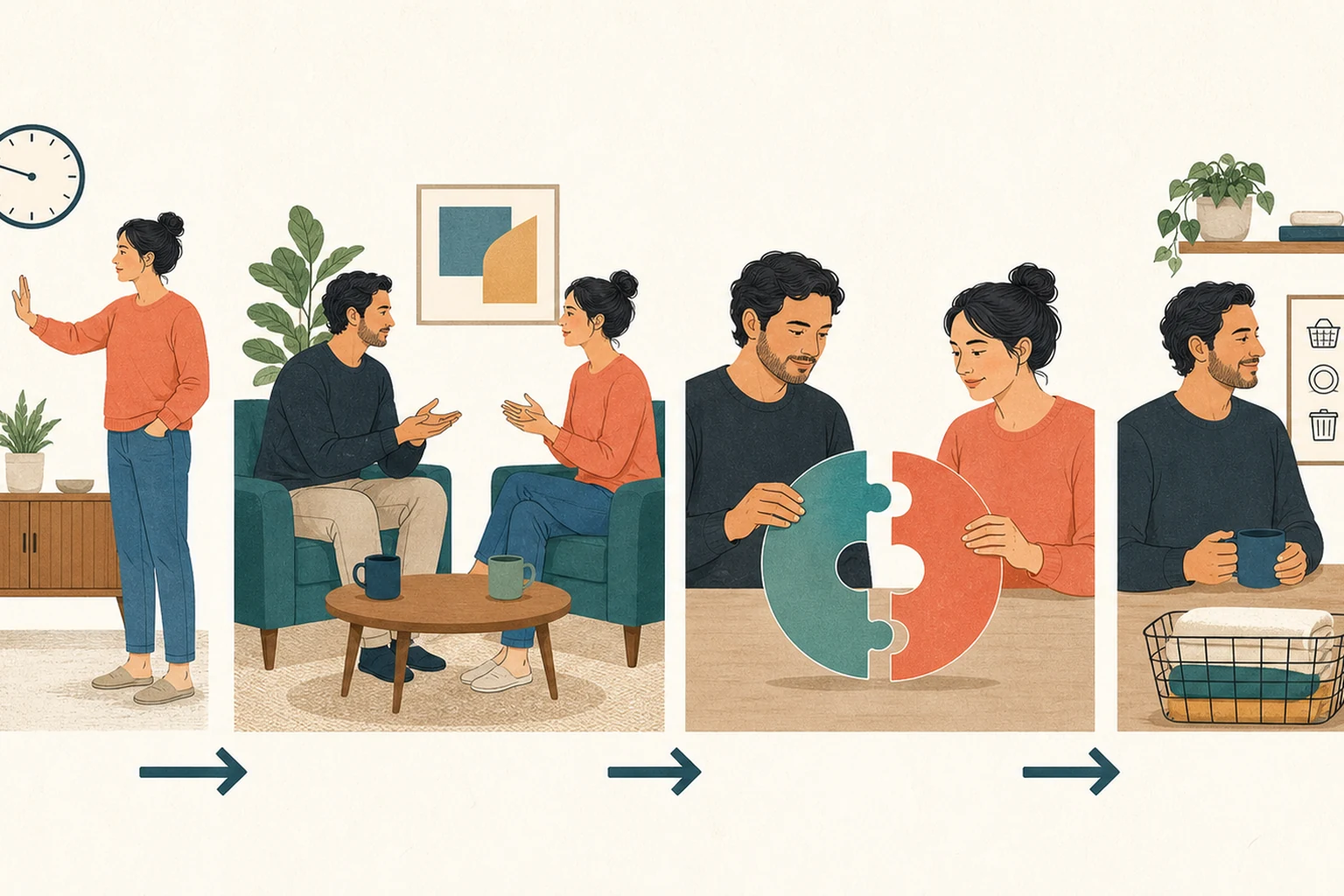
A five-question conflict repair
The Gottman Institute aftermath-of-a-fight guide invites partners to describe feelings, their separate realities, triggers, responsibility, and constructive plans after both are calm. A shorter version is:
1. What happened, without “you always” or “you never”? 2. What did I feel, and what was I afraid it meant? 3. How did you experience the sequence differently? 4. What was my responsibility, including tone, withdrawal, or assumptions? 5. When this pattern returns, what will each person do first?
The purpose is not to prove who had the superior logic. It is to create shared knowledge about the injury, responsibility, and next behavior.
When type language should stop
Needs for solitude, directness, and difficulty naming emotion do not justify control, humiliation, threats, surveillance, punitive silence, or prolonged disappearance. When one partner fears disagreement or faces retaliation for setting a boundary, prioritize safety and outside support instead of studying INTJ communication.
Look for counterevidence too. Is this person warm with friends but dismissive only toward a partner? Do they require extensive space only during overload? Are they willing to learn an expression the other person can recognize? Those observations separate preference from stress, skill, and the condition of the relationship.
Continue with the INTJ type page, compare frameworks in MBTI and love languages, or use the relationship advice source guide. Type cannot choose a partner. It can help two people make care, needs, and repair more explicit.
Related reading
MBTI Test Complete Guide: personality types, accuracy, careers, relationships, and how to use the results
A complete guide to the MBTI test, the 16 types, result reading, and practical use cases.What makes an MBTI analysis deep instead of generic?
An MBTI analysis is deep when it explains behavior, context, limits, nearby-type confusion, and what to read next. It is generic when it mainly repeats flattering adjectives that could fit many people.ENFP Compatibility: Common Pairings and What Makes Them Work
A practical comparison of four commonly discussed ENFP pairings without pretending MBTI can rank relationship success.Keep exploring
Take the test to see your type, or browse more MBTI guides and answered questions.