
Contextual article
What Is an Intuitive Personality? Traits, Examples, and All 8 N Types
25 min read
· By itypelab Editorial Team
· 2026-07-30
Define the MBTI N preference, name all eight intuitive types, and compare pattern-seeking with evidence checking in real scenes.
Best for readers who already know MBTI and want to connect it to real work, relationships, or self-observation.
This article breaks a common MBTI topic into more usable signals instead of stopping at a quick answer.
You'll leave with a clearer interpretation frame and a better sense of whether to continue into a type page, question page, or guide.
An intuitive personality is an MBTI type with the letter N. Common traits include spotting a shared pattern across separate events, thinking about where something may lead, enjoying questions about why and what else is possible, and using analogies or big-picture explanations. The eight intuitive types are ENFJ, ENFP, ENTJ, ENTP, INFJ, INFP, INTJ, and INTP.
Suppose a colleague says, “Customers have dropped out at the second signup step for three weeks.” An intuitive person may first wonder whether the whole flow creates distrust, whether the problem will later reduce paid conversions, or whether signup could work in a different way. They may not immediately ask for the exact weekly totals. That habit can reveal connections and new directions. Taken too far, it can also mean trusting an explanation before checking the data or getting bored with repetitive detail work.
You may lean toward N if several of these happen often:
- One example quickly reminds you of a broader pattern or of another situation that looks unrelated.
- When learning a tool, you first want to know what it can solve before memorizing where every control is.
- In meetings, you would rather discuss what may happen next and what else is possible than only restate the current facts.
- You often explain an idea by saying “this is a bit like…” and using an analogy.
- You sometimes miss a date, step, or exact number and have to return deliberately to check it.
N does not mean smarter, automatically creative, or detached from reality. It only describes whether someone commonly notices possible meaning before the immediate specifics. Either approach can lead to a strong answer, and either can produce mistakes.
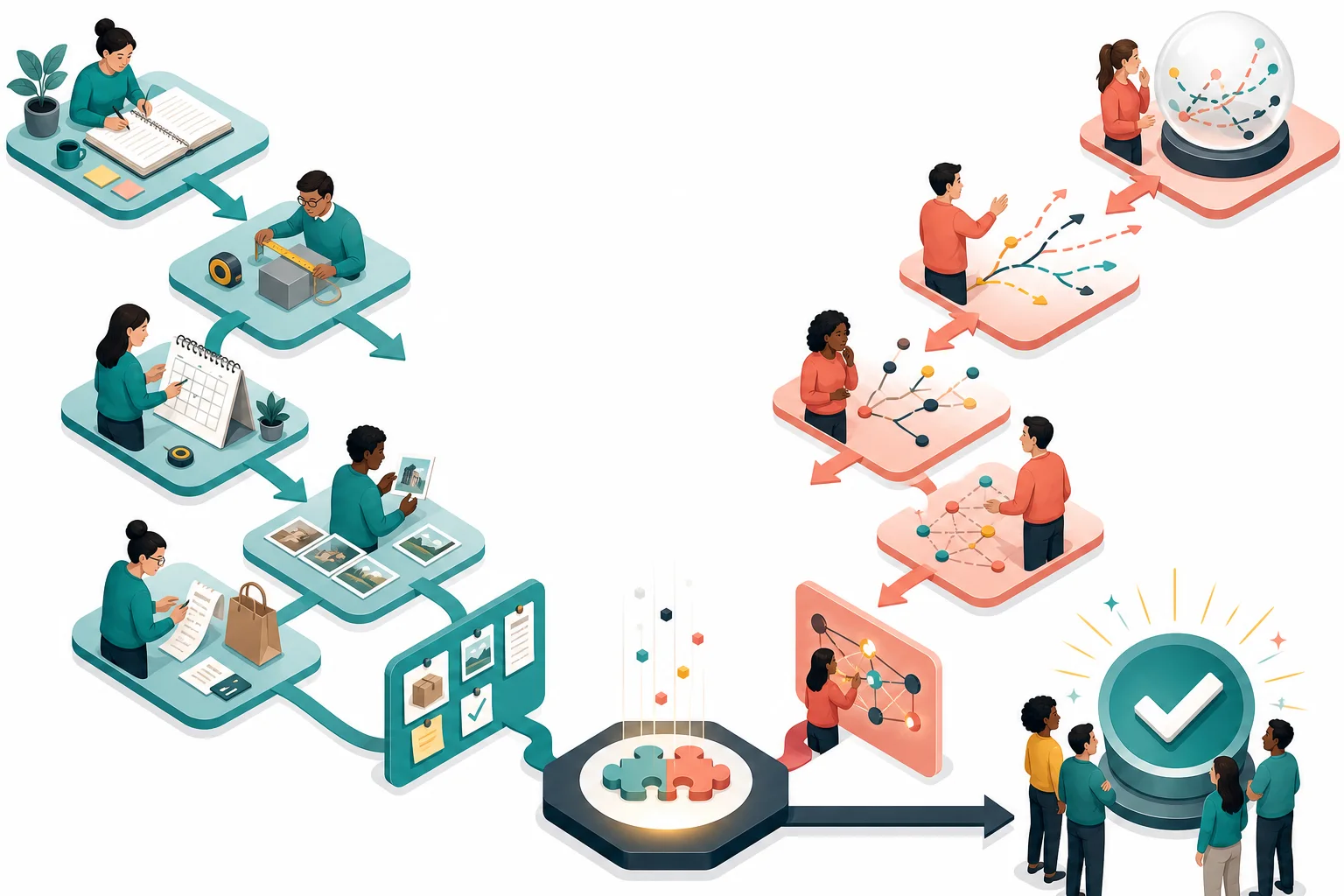
The eight intuitive personality types
| Type | A common first focus |
|---|---|
| ENFJ | The direction a group could grow toward |
| ENFP | Several new possibilities and what feels personally meaningful |
| ENTJ | A future goal and the system needed to reach it |
| ENTP | Alternative explanations and assumptions worth testing |
| INFJ | An underlying pattern and its likely human consequences |
| INFP | Personal meaning and possible ways to express it |
| INTJ | A long-range model and the structure behind it |
| INTP | A conceptual model and whether its logic holds |
These are concise prompts, not full profiles. E/I, T/F, and J/P change how the N preference is expressed.
What this guide gives you
- Three same-scene comparisons: proposal review, learning a tool, and troubleshooting a bug.
- A way to tell a natural first step from learned skill, a job requirement, or a stereotype.
- A way to state what the facts mean, then check that idea against new evidence.
What S and N Actually Describe
Sensing (S) and Intuition (N) describe the information you naturally look for first in a new situation.
S-leaning people often ask: “What happened?” “What are the numbers?” “What do we do next?” They usually check current facts and past experience before drawing a conclusion.
N-leaning people often ask: “What does this mean?” “What could happen next?” “Is there another way?” They usually connect separate details into an explanation, then return to the facts to check it.
Neither starting point is better. Problems arise when one person is still checking what happened while the other has already moved on to what it might mean.
The Myers-Briggs Foundation describes the MBTI preferences as different ways people direct energy, take in information, decide, and approach the outside world. Its overview of the 16 personality types keeps Sensing and Intuition inside that four-preference framework; it does not rank one as more capable.
Where the Difference Shows Up Most Clearly
Case 1: Two reviewers read the same proposal
An S-type may read a project proposal from start to finish, checking each claim against the data and marking any missing step. They often ask, “Where is the data for this?” or “What date does ‘soon’ mean?”
An N-type may first look at the proposal's overall direction. They often ask, “What happens if this assumption is wrong?” or “Does this solve today's problem but create another one later?”
Both kinds of feedback are useful. A team that skips the S questions may miss a broken step during delivery. A team that skips the N questions may execute the current plan well while missing a better direction.
In meetings and discussions:
S-types often need the specifics before they are ready to decide. “What is happening now?” and “What are the next steps?” feel necessary, not overly detailed.
N-types often want to agree on the direction and reason before reviewing every detail. A long discussion of the current state can feel premature if the team has not agreed on what it is trying to achieve.
The result is predictable: S-types think N-types are jumping ahead without enough facts, while N-types think S-types are stuck in details. Both are noticing a real gap. They disagree about which question should come first.
Case 2: Two colleagues learn the same analytics tool
Give two people the same analytics tool before a Monday reporting deadline. An S-leaning person may open a real dashboard, change one setting at a time, check what numbers move, and save the steps that actually produce the report. Their confidence grows because the tool has answered through direct feedback. An N-leaning person may first ask how the tool is organized, what assumptions sit behind each metric, and how this product differs from the old system. Their confidence grows once the logic of the tool makes sense.
This is the kind of practical difference that helps more than the label “concrete versus abstract.” Both people can learn the tool. The difference is whether the first useful information comes from trying the thing or from understanding the pattern behind the thing.
A Practical Self-Assessment
| Situation | More S-leaning Response | More N-leaning Response |
|---|---|---|
| New project kickoff | "What's our scope and what's the current baseline?" | "What are we ultimately trying to achieve and what's the best path?" |
| Data report review | Checks figures for accuracy, consistency, timeframe | Scans for patterns, jumps to implications |
| Unexpected problem | "What specifically happened? When? What's the impact?" | "Why is this happening? What does this indicate about the broader system?" |
| Planning discussion | "What resources do we have and what's a realistic timeline?" | "What direction maximizes long-term value and what would that look like?" |
| Meeting notes | Documents specific decisions, action items, and owners | Records implications, open questions, and directional conclusions |
If you consistently choose one side across several situations, that may be your natural leaning. If your answer changes with the topic or role, you may not have a strong S or N preference.
Case 3: ISTP and INTP troubleshoot the same mobile bug
Nearby types are useful because they remove some distracting overlap from the comparison. ISTP and INTP both share I, T, and P, so the S/N difference has more room to show itself.
Picture a product bug: a checkout button works on desktop but fails on one mobile browser. An ISTP-style approach often begins with the live object. Reproduce the bug, tap the button, inspect the device, change one variable, check the network request, test again. The question is: what does the system do when I touch it? An INTP-style approach often begins with the explanation. Which conditions must be true for desktop to work and mobile to fail? Is this a state issue, browser behavior, event handling, or a hidden assumption in the component? The question is: what model explains all the symptoms?
Neither route is automatically better. Under time pressure, the ISTP path may find the failing interaction faster. When the bug is part of a larger design flaw, the INTP path may reveal why the same issue will keep returning. The point is not to rank them; it is to notice the first move.
The same difference can appear outside technical work. If a bicycle gear slips, an ISTP may turn the pedal, listen, adjust cable tension, and feel the change. An INTP may first reason through how the derailleur, chain line, and load interact. Both can fix the bike. S/N asks which kind of information your mind reaches for before training and habit take over.
Why S/N Friction Is So Common in Teams
S/N differences can create repeated team friction because both sides are asking necessary questions in a different order.
The S-leaning colleague says: verify the current situation before deciding what to do next. Otherwise, the team may act on a false assumption.
The N-leaning colleague says: agree on the goal and direction before spending hours on details. Otherwise, the team may improve the wrong thing.
The disagreement is usually about which question comes first. During delivery, the team may need more detail checking. During early planning, it may need more discussion of direction and possible outcomes.
Name the step out loud: “First, let’s confirm what is happening. In the next meeting, we’ll compare possible directions.” That one sentence stops two useful approaches from talking past each other.

How to Use This in Practice
If you lean S and a colleague jumps ahead, ask: “What would we need to see to know whether that idea is right?” This turns a broad possibility into something the team can check.
If you lean N, start an idea with one or two concrete facts: “This is happening now, so I think this direction is worth testing.” Your colleague can then evaluate the idea instead of first asking where it came from.
For a broader understanding of how MBTI dimensions interact and create the 16 types, the four MBTI letters guide explains all four dimensions and how they combine. If you want to compare this page with a more daily-life version, read S vs N in daily life. If you want to know your own type first, take the MBTI test.
Sources and limits
- Myers-Briggs Foundation: The MBTI preferences explains Sensing and Intuition as different ways of taking in information.
- Myers-Briggs Foundation: The 16 personality types explains the four preference pairs used in standard MBTI.
These cases illustrate first moves, not fixed scripts. Expertise, role, language, consequences, and deliberate practice can change visible behavior; one scene cannot prove a stable preference.
Related reading
MBTI Four Dimensions Explained — A Complete Deep Dive
A thorough exploration of all four MBTI dichotomies, covering real definitions, persistent misconceptions, practical self-identification tips, and how the dimensions combine to shape each unique type.Why does my MBTI type description feel accurate but shallow?: MBTI after test
A description can feel accurate because it matches the vibe, but still be shallow if it cannot explain behavior, stress, nearby types, and real-life scenes. Depth starts when the page can separate similar patterns.How to Read an MBTI Result Report: A Worked Example
Start with the four dimensions, pay extra attention to close scores, and treat the personality description and career suggestions as claims to check rather than a verdict.Keep exploring
Take the test to see your type, or browse more MBTI guides and answered questions.