
Contextual article
Rarest Personality Type: Why the Answer Changes and What Rarity Does Not Mean
14 min read
· By itypelab Editorial Team
· 2026-07-22
Ask who was counted, when, where, and by which test before treating one rarity estimate as a global fact or a rank of people.
Best for readers who already know MBTI and want to connect it to real work, relationships, or self-observation.
This article breaks a common MBTI topic into more usable signals instead of stopping at a quick answer.
You'll leave with a clearer interpretation frame and a better sense of whether to continue into a type page, question page, or guide.
There is no timeless, worldwide answer to “What is the rarest personality type?” A frequency table describes a particular sample: who answered, where and when they answered, which instrument classified them, and whether the results were adjusted to resemble a larger population. Change those inputs and the lowest-frequency type can change too.
Rarity also says nothing about worth. A less common result is not evidence of greater intelligence, creativity, maturity, or insight. It is a count inside a dataset, not a rank of people.

Page deliverables
- Six questions to ask about any “rarest type” claim.
- Three cases showing why an online platform, a workplace team, and a country comparison produce different answers.
- A safer way to use frequency information without building identity status around it.
Ask where the number came from before reading the ranking
| Question | Why it changes the answer |
|---|---|
| Who was included? | Website visitors, employees, students, and a population sample are not interchangeable. |
| Where and when? | Language, country, access, and collection period affect who appears. |
| Which instrument? | Different questionnaires and scoring rules do not classify every person the same way. |
| Was participation voluntary? | People attracted to personality content may differ from people who never take a test. |
| Were results weighted? | A raw respondent count may not represent the age, gender, or regional mix of a population. |
| How uncertain is the estimate? | Small subgroups and close preference scores make precise rankings fragile. |
The Myers-Briggs Company's MBTI Manual Supplements name the assessment version, countries, languages, sample sizes, and sample descriptions behind their global research. That is the level of context a frequency claim needs. The Myers-Briggs Foundation's overview of the 16 personality types describes preference combinations; it does not make rarity a quality scale.
Case 1: A free-test site calls one result the rarest
Maya takes a free online test and receives INFJ. The result page says her type is rare, and a social post turns that into “only a tiny group can understand people this deeply.” Maya starts treating ordinary disagreement as proof that others cannot relate to her.
The site's number may describe its audience, an external estimate, or a branded model rather than all adults. Even if the estimate were accurate for a defined sample, the conclusion about empathy would not follow. Maya should first verify whether INFJ fits her repeated information and decision preferences using the deep type-reading guide. Frequency cannot perform that verification.
Case 2: The rarest type in a twelve-person team
A product team has one ESTJ and three INFP colleagues. Someone jokes that ESTJ is “the rare type here,” while an internet chart labels another type rare in the population. Both statements can be numerically true because they answer different questions.
The team count is too small and selected by hiring, function, location, and chance. It can help the team notice whose preferred working sequence is underrepresented, but it cannot estimate population frequency. The practical question is whether meetings make room for different evidence and decision styles, not which colleague owns the most exclusive label.
Case 3: Two countries produce different lowest-frequency types
One report samples employed adults in one country; another collects volunteers from a translated website in another. The rankings differ. That does not prove national character. Translation, access, age distribution, occupational mix, response style, and scoring can all move the result.
A responsible comparison needs similar tests, similar groups of people, collection dates, and an explanation of possible error. Without those details, you can say that the two reports differ. You cannot conclude that two countries have different personalities.
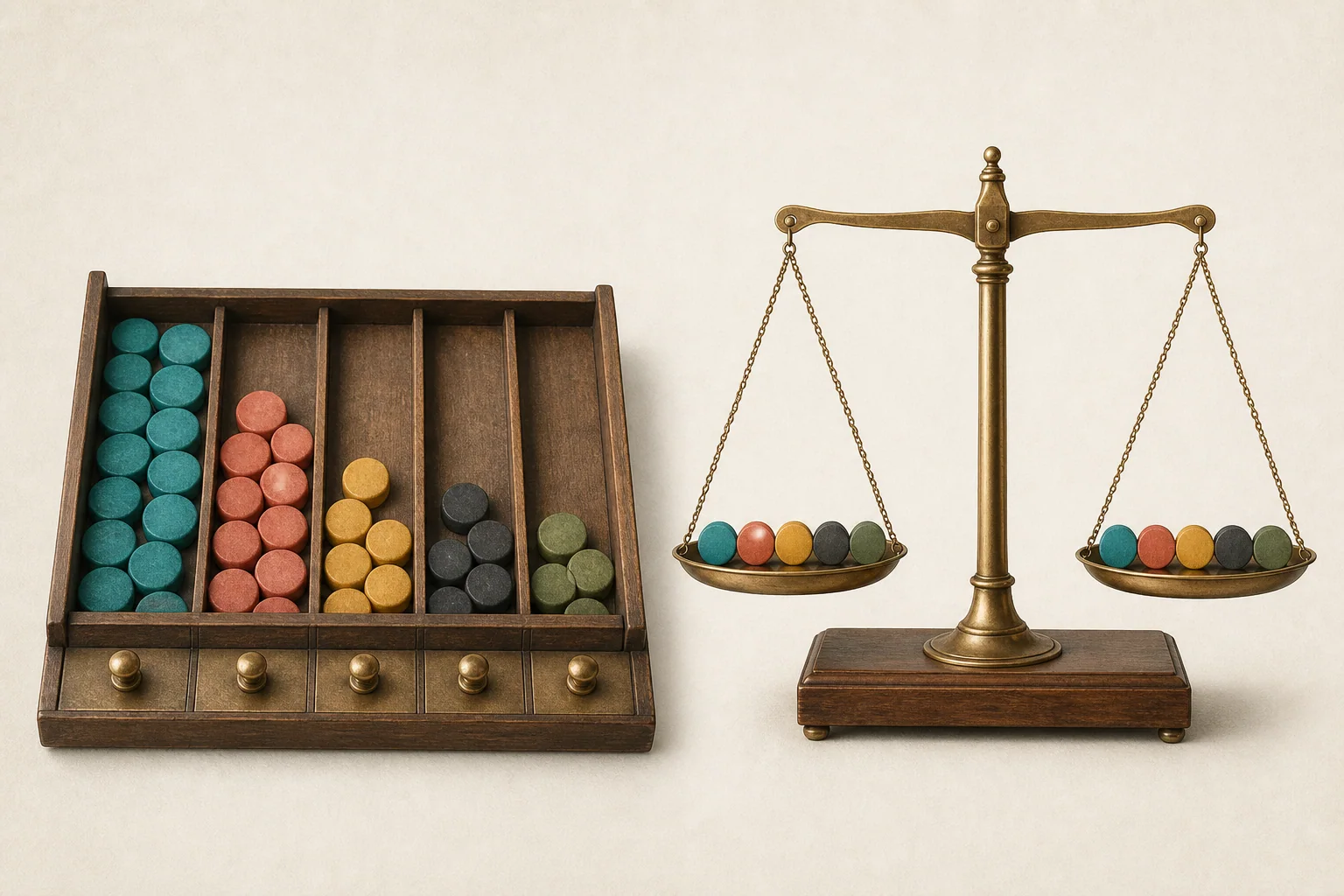
A six-question rarity check
Before repeating a chart, write down:
1. The population the number actually describes. 2. The sample size and recruitment method. 3. The instrument and classification rule. 4. The collection year and language. 5. Whether weighting or uncertainty is reported. 6. What practical decision the number is supposed to support.
If the source cannot answer the first five questions, do not convert its ranking into a global fact. If you cannot answer the sixth, the number may be interesting but not useful.
What rarity can and cannot tell you
Frequency can describe how often a classification appeared in a defined dataset. It can sometimes help educators or facilitators avoid assuming that one communication preference is universal. It cannot tell you whether your result is correct, whether a type is more valuable, or whether you will be lonely, gifted, compatible, or successful.
For your own result, start with the result deep-reading checklist, compare the four MBTI letters, and use the type library to test nearby alternatives. Those steps answer “Does this fit?” Rarity answers only “How often did this label appear here?”
Sources and limits
- The Myers-Briggs Company: MBTI Manual Supplements documents named samples and their composition.
- Myers-Briggs Foundation: The 16 MBTI personality types supports the framework boundary.
This page does not estimate a current global rarest type. It explains why a defensible answer must name its dataset and why no frequency estimate should become a human-value ranking.
Related reading
All 16 MBTI Personality Types — Complete Overview
A comprehensive guide to all 16 MBTI personality types, organized by the four temperament groups, with full profiles, commonly confused pairs, type distribution patterns, and answers to frequently asked questions.What does J/P really mean in MBTI? It is not just organized versus messy
A direct-answer page about the real meaning of J/P, common misunderstandings, and how to judge the dimension in real life.Most Common MBTI Type: US Data, China Samples, and Website Differences
Start with the actual most-common MBTI figures, then separate US estimates, China report samples, and website-user data.Keep exploring
Take the test to see your type, or browse more MBTI guides and answered questions.