
Contextual article
MBTI and Burnout: What Type Can and Cannot Explain
28 min read
· By itypelab Editorial Team
· 2026-08-03
No type is the burnout type; examine workload, control, support, fairness, recovery, and the work arrangements that drain you.
Best for readers who already know MBTI and want to connect it to real work, relationships, or self-observation.
This article breaks a common MBTI topic into more usable signals instead of stopping at a quick answer.
You'll leave with a clearer interpretation frame and a better sense of whether to continue into a type page, question page, or guide.
If you suspect burnout, do not start by searching “why my type burns out.” Start with whether the job itself is crushing people. In ICD-11, the World Health Organization describes burnout as an occupational phenomenon, not a medical condition. It mainly looks at three changes: lasting exhaustion, growing distance or cynicism toward work, and a weaker sense that you can still do the job well. Those changes come from chronic workplace stress that has not been handled, not from one MBTI type being born to burn out.
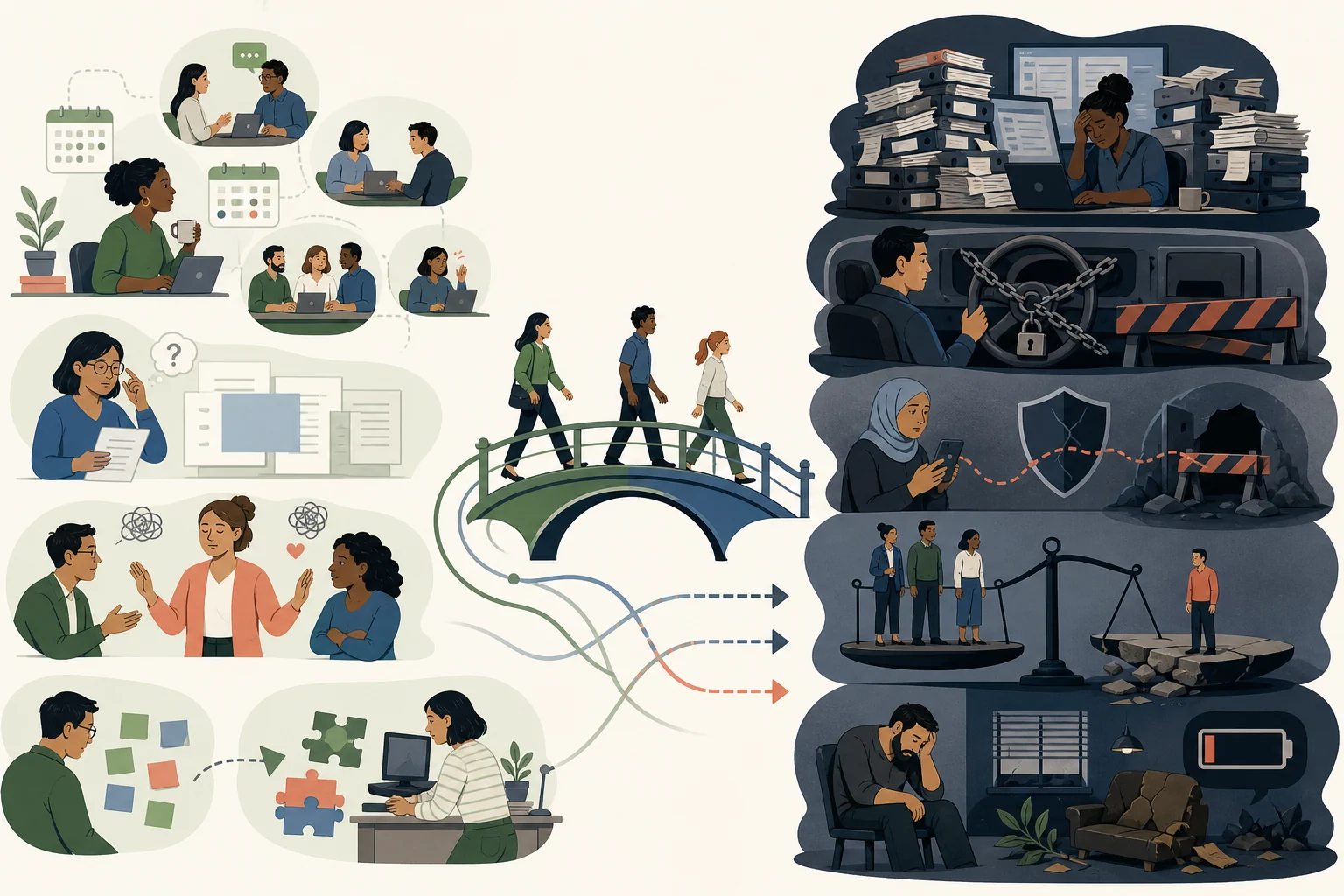
The more useful check is what happens in the workday. Is there more work than anyone can finish in paid hours? Are lunch, evenings, and leave constantly interrupted? Do priorities change every day without anyone saying which old task can stop? When work gets hard, does real help arrive? Are assignments, credit, and opportunities fair? Can people report mistakes, bullying, or harassment without retaliation? These job conditions usually matter more than four letters.
Some signals are easy to recognize. Seven meetings followed by two hours of catch-up work means the schedule and workload are too heavy. Sending every angry customer to “the caring teammate” is unfair emotional labor. Announcing a new top priority every morning without removing an old one is a management problem. Searching for type-based burnout signs can distract from the calendar, staffing, and work allocation that are actually causing the strain.
MBTI can add only a little context. It may help explain why nonstop meetings drain one person more, or why another struggles with surprise changes. It cannot fix understaffing, and calling someone an F does not make them responsible for every distressed customer. If exhaustion, dread, concentration problems, or inability to work have lasted for weeks, record actual hours and priority changes and speak with someone who can change the work. Severe insomnia, panic, depression, inability to function, or thoughts of self-harm need prompt professional or emergency support, not a personality article as a diagnosis.

Where MBTI can add a small amount of useful detail
E/I may affect how costly a day of continuous interaction or prolonged isolation feels. S/N may affect strain when work demands only repetitive detail or only ambiguous vision without concrete instructions. T/F may affect which kind of conflict or emotional labor feels especially heavy. J/P may affect friction in environments with either constant unannounced change or no room to adapt.
These are work arrangements that some people may find especially tiring, not burnout symptoms or rankings. An Extravert can be exhausted by meetings; an Introvert can thrive in public-facing work. Skill, meaning, choice, breaks, team climate, health, and home responsibilities all change the experience. In plain terms, “this meeting format wears me out” may improve when the format changes. If someone has been exhausted, detached from work, and unable to work effectively for a long time, changing the meeting format alone is unlikely to be enough. Workload, constant changes, unfair distribution, recovery, and support also need attention. Use the four-dimension guide for definitions, workplace advice for limits, and the stress and growth guide for adjacent reading.
Three workplace scenes
Case 1: Seven meetings and two hours of catch-up
Rae has seven meetings in one day. Two require decisions, but the reading arrives during the call. By evening she cannot concentrate, then spends another two hours doing individual work. She begins searching for “Introvert burnout” because she needs quiet to think. That label feels personal and therefore strangely convincing, but it hides a process problem: the calendar has placed discussion, decision-making, and focused production on top of one another.
The team audits the calendar. Two meetings become written updates, decision documents arrive a day early, a quiet lunch hour is protected, and one afternoon each week has no internal meetings. Rae tracks whether energy and focus improve for two weeks. If workload still exceeds paid capacity, the manager must reduce or reassign work; a better meeting style cannot create missing hours.
She can make a direct request: “I am not trying to do less. Meetings are taking the time I need to make decisions and write the plan. Could we keep Tuesday and Thursday afternoons meeting-free and send decision materials a day ahead?” The request names the effect, the change, and the point at which the team can review it. It gives the manager something to approve instead of asking them to guess what “too much” means.
Case 2: Constant emotional labor
Luis handles angry customers while also being expected to reassure teammates. His manager praises him as “the Feeling person” and sends every sensitive case his way. He begins to dread new messages, feels cynical about requests for help, and notices that his empathy is being treated as a resource anyone can draw from. The label has turned a skill into unlimited availability.
Telling Luis to set better boundaries is not enough. His manager needs to distribute sensitive cases across more people, say when another person must step in, allow breaks after severe incidents, and provide training and real support. Luis can state which cases require backup and stop being the automatic emotional buffer. Caring about people does not create an obligation to absorb everyone else’s distress.
Case 3: Priorities change every day
An operations team receives a new “top priority” almost daily. Work is abandoned without explanation, success measures change, and nobody knows who can override the plan. One employee calls herself “too J for startups,” but the whole team is losing time: the same report is revised four times and still does not go live. The problem is not that one person likes order. The team has no visible decision owner or trade-off rule.
Leadership puts all work on one priority list and names one person who can change the order. Every change needs a reason. When urgent work comes in, the team must also say which existing task will stop. They check the list twice a week instead of overturning it every day. Personal planning preferences may affect frustration, but conflicting orders and endless switching hurt the whole team. A person can learn to tolerate some uncertainty; they cannot personally resolve three leaders giving mutually exclusive orders.
A job-factor audit
Rate each item from 0 (manageable) to 3 (severe), using the last two weeks rather than your general impression:
| Factor | Concrete check |
|---|---|
| Workload | Can paid hours cover required work? |
| Recovery | Are breaks, evenings, sleep, and leave protected? |
| Control | Can you influence methods, sequence, or pace? |
| Clarity | Are priorities, authority, and success measures stable enough? |
| Support | Does help arrive when work or conflict exceeds capacity? |
| Fairness | Are load, credit, opportunity, and consequences distributed transparently? |
| Safety | Can you report risk, mistakes, bullying, or harassment without retaliation? |
| Values | Are you repeatedly required to act against an important professional or personal value? |
Circle every 2 or 3. For each one, write what you want to change, who has the authority to agree, and when you will check the result. “Be more resilient” is too vague. “Give two weekly reports to another teammate for four weeks, then check next Friday whether overtime has fallen” is specific enough to act on. If an item scores 0 but one arrangement still drains you, note that separately. Not every difficult fit is burnout, but it can still help explain what needs to change in the workday.
| Situation you observed | Request to a manager |
|---|---|
| Average meetings take 5.5 hours a day, leaving paid work for the evening. | “Can we protect two meeting-free afternoons next week and review overtime on Friday?” |
| Sensitive customer cases all go to one person, with no backup after a serious incident. | “Can we set a weekly case limit, a backup rotation, and same-day manager support for severe complaints?” |
| Priorities change without naming what stops. | “Can we keep one ranked list, name one person who can change it, and record which task pauses each time?” |
| Breaks or leave are routinely interrupted. | “Can we define coverage so lunch and approved leave are not treated as available work time?” |
Bring three things to the conversation: a two-week record, the two highest-scoring conditions, and one request that can be observed. For example: “Over the last two weeks I averaged 5.5 meeting hours per day and completed individual work at night. I am requesting two meeting-free afternoons each week and a review next Friday.” That is closer to the problem than saying, “I may have a burnout personality.”
When to seek more help
Persistent exhaustion, serious sleep disruption, panic, depression, substance use, physical symptoms, inability to function, or thoughts of self-harm deserve qualified support, not a personality explanation. Seek local emergency help immediately if there is imminent danger. A clinician can assess health conditions that overlap with exhaustion; an employee representative, union, HR channel, regulator, or legal adviser may be relevant for unsafe work, although the appropriate route depends on local context and whether the channel is trustworthy.
The WHO's page on burn-out as an occupational phenomenon provides the definition and explicitly does not classify it as a medical condition. The Myers & Briggs Foundation's preference overview explains type preferences; it does not establish burnout risk by type.
The next useful action
Rate the job conditions before reading a “how each type burns out” list. Start with the highest score, ask for one specific change, and agree on who will handle it and when you will look at the result. You can also change one especially tiring work habit, such as meetings with no preparation or last-minute schedule changes. If workload, unfairness, or safety problems remain, do not treat a lack of recovery as weak willpower. Ask which demands must be reduced, who can help, and what improvement should be visible after a few weeks.
First separate what you can change from what someone else must decide. You may be able to turn off alerts, block focus time, or ask for an agenda. A manager may need to redistribute cases, set priorities, approve leave, or stop after-hours messages. Senior leaders may need to add staff, change unrealistic targets, investigate retaliation, or redesign an unsafe role. Asking the wrong person often turns a workplace problem back into another demand that the employee “take better care of themselves.” If the person you ask has no authority, ask who does and bring the same record to them.
Track the result without turning recovery into another performance target. Once or twice a week, note working hours, breaks, sleep disruption, dread before work, ability to concentrate, and whether promised changes occurred. Look for a trend over several weeks, not one good afternoon. Resting for a few days may improve symptoms without making the job reasonable; changing a meeting format may help without resolving burnout. If conditions do not change after a clear request, the record helps you discuss escalation, leave, medical support, or a job change with better information.
It also makes a later conversation more concrete: dates, demands, attempted changes, and outcomes are easier to act on than a general statement that work feels wrong. If reducing workload, restoring control, clarifying duties, and receiving support lead to improvement, there is no need to invent a personality cause. If they do not, that is information too.
Finally, saying “I cannot keep doing this under these conditions” is not an admission of a character flaw. MBTI may help you describe which arrangement costs you more, but it cannot perform the organizational work of reducing demand, making distribution fair, protecting recovery, or keeping people safe.
Related reading
Where can I read a deep INFJ explanation instead of shallow type stereotypes?
A guide to finding deep INFJ explanations and other MBTI type pages that go beyond stereotypes and explain real-life patterns.Is MBTI accurate? What it can help with, and what it should not replace
A question page about MBTI accuracy, usefulness, and limitations.INFJ Personality Weaknesses: From Labels to Observable Patterns
Replace fixed INFJ flaws with a practical pattern worksheet for conflict, overcommitment, idealism, and withdrawal.Keep exploring
Take the test to see your type, or browse more MBTI guides and answered questions.