
Contextual article
How Many MBTI Questions Are Enough? Balancing Length, Accuracy, and Fatigue
24 min read
· By itypelab Editorial Team
· 2026-07-20
Enough questions means adequate coverage without excessive repetition or fatigue; length helps only when additional items contribute independent information.
Best for readers who already know MBTI and want to connect it to real work, relationships, or self-observation.
This article breaks a common MBTI topic into more usable signals instead of stopping at a quick answer.
You'll leave with a clearer interpretation frame and a better sense of whether to continue into a type page, question page, or guide.
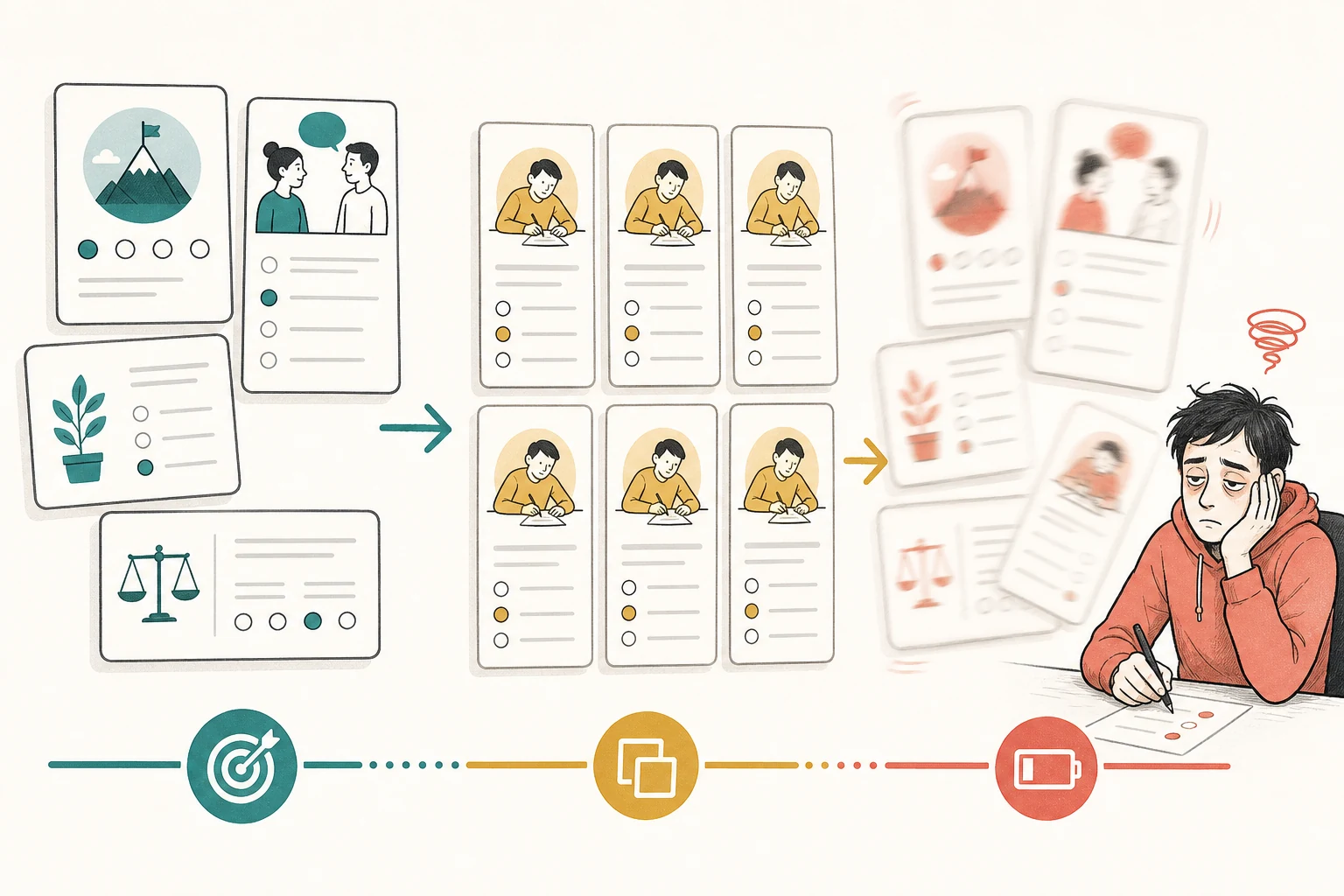
There is no universal number of MBTI questions that makes a test “long enough.” Twenty-four items may be too narrow, while ninety may repeat the same idea. The real question is whether additional items sample new behavior, reduce the influence of one accidental answer, and still earn careful responses before fatigue cancels those gains.
Do not judge a test only by whether it has 20, 60, or 93 questions. Separate four issues: whether it measures consistently, whether it measures the preference it claims to measure, how uncertain a close classification is, and whether the report makes the result testable in real life. Item count can affect part of that chain, not all of it.
“Accurate” hides four different quality questions
| Quality question | Plain-language meaning | How more items may help | What more items cannot repair |
|---|---|---|---|
| Reliability | Similar answering states produce reasonably stable scores | Distinct items can reduce dependence on one odd response | A questionnaire that consistently measures the wrong thing |
| Validity | The test measures the preference it claims to measure | Broader behavioral sampling can cover the construct | Defining shyness as I or punctuality as J |
| Precision | A 51/49 result is treated differently from 80/20 | More evidence can estimate uncertainty near a boundary | A site that still outputs only a hard label |
| Interpretability | The result becomes a real-world question | Better feedback can identify close dimensions | A report containing only four letters and praise |
The open-access Standards for Educational and Psychological Testing treats validity, reliability, fairness, and intended use as connected parts of test evaluation. It does not provide a question-count threshold for accuracy because quality is not defined by length alone.
Compare three questionnaires before calling the longest one best
Imagine three unofficial tests.
| Test | Length | Item design | Result feedback | Main risk |
|---|---|---|---|---|
| A | 24 | Six concrete but narrow items per dimension | Type plus dimension ranges | A few recent situations can move the result |
| B | 80 | Many paraphrases of sociability and organization | Four letters only | Length creates certainty while coverage stays narrow |
| C | 60 | Work, relationships, recovery, and change; some reverse items | Dimensions, close scores, and follow-up checks | More effort and the limits of all self-report |
From length alone, B looks most serious. After inspecting design, C offers more useful signals and A may be an honest low-cost orientation. This does not prove C is validated. Reliability and validity require research evidence, not an editor's judgment from the interface.
Case one: twenty party questions may measure sociability very consistently
Jordan takes a short test whose E/I items focus on parties, strangers, and public speaking. Jordan presents confidently to clients and enjoys dinner with friends, so the result is strongly E. Yet sustained interaction is draining, important ideas are formed in writing, and recovery happens alone.
Extending the questionnaire to 60 items will not help if the extra items are still variants of “Do you start conversations?” It may produce a more stable E result while continuing to confuse Extraversion preference with social skill and occupational practice.
Useful additional items would change the evidence conditions: what happens when nobody expects participation, whether thinking develops during speech or after it, and whether satisfying social contact supplies energy or creates a need to recover. New contexts add information; synonyms add volume.
Case two: fatigue changes the response strategy halfway through a long test
Alina starts a long questionnaire at 11 p.m. For the first 40 items she recalls examples. Later she notices repeated wording, responds from first impressions, and chooses the midpoint on the last ten questions. The report shows four weak dimensions, and she concludes that her personality is too complex for tests.
The immediate evidence is that the response process changed. The extra items' potential information was offset by fatigue, repetition, and completion pressure. A defensible next move is to preserve the specific uncertainty, return during an ordinary alert period, and choose a tool with clearer documentation. It is not to start a 150-item test immediately.
Progress indicators, pausing, realistic time estimates, and non-redundant items can reduce this risk. They cannot eliminate the limits of self-report or guarantee that the respondent is using the same frame throughout.
Case three: one hundred work-framed items can stabilize a role, not a preference
An operations lead owns deadlines, dependencies, and release risk. Every item about plans, closure, and dates receives strong agreement, producing a stable J score. On personal trips, independent learning, and low-stakes weekends, the same person leaves options open and feels little distress when plans change.
If most of a hundred items invoke accountable work, the test can describe the role with impressive precision. Better item coverage crosses high-consequence and low-obligation settings. Better answering recalls ordinary patterns across the last six months rather than the most rehearsed professional self. The work-self versus everyday-self guide helps audit this problem.
Audit whether extra items add information
Sample ten early and ten middle items and ask:
1. Does an item substitute ability for preference, such as presentation skill for thinking aloud? 2. Does one answer sound morally better, such as empathic versus cold? 3. Are work, parties, or school the only context? 4. Are many items synonyms without new conditions? 5. Can respondents express moderation, and does the report preserve close scores? 6. Does the site identify the developer, version, construct, scoring approach, and limitations?
| Quick signal | Stronger design | Warning sign |
|---|---|---|
| Context coverage | Work, relationships, recovery, change, and ordinary decisions | Every E/I item asks about parties |
| Answer framing | Both poles are neutral and have tradeoffs | One pole sounds mature or kind |
| Repetition | Same preference checked under new conditions | Same sentence repeatedly paraphrased |
| Result display | Closeness, limits, and next checks remain visible | A 51% score becomes a fixed identity |
| Documentation | Developer, version, purpose, and method are named | “Most accurate” is the only evidence |
When a short test is enough
A short test can work as a first orientation when the reader is curious, the stakes are low, and the result remains a hypothesis. Its job is routing: identify obvious dimensions and one uncertainty worth reading next.
It should not support diagnosis, hiring, relationship decisions, or forced certainty across four close dimensions. If the first result broadly fits, learning how to read a worked MBTI report may add more value than switching tests.
When a longer assessment is worth the effort
Length becomes worth considering when the first session was rushed or badly translated, one dimension remains close over time, the tool gives documented and richer dimension feedback, or a qualified practitioner uses a formal assessment within a feedback process.
The Myers-Briggs Company's official MBTI assessment overview emphasizes research, interpretation, and development use, not just questionnaire completion. A formal assessment still does not become a machine for predicting life outcomes because it contains more items.
Before retesting, read the close dimension directly. When one letter keeps moving, investigating that boundary is more efficient than answering every question again.
An eight-point test-selection checklist
Mark each item yes, no, or undocumented. “Undocumented” is itself risk information.
- The construct is explained in ordinary language.
- Items cover several ordinary-life settings.
- Both answer poles are neutral rather than moralized.
- A version, developer, and update history are visible.
- Dimension closeness remains visible in the report.
- Reliability, validity, or at least method documentation is available.
- Preference is separated from skill and virtue.
- Limits for diagnosis, hiring, and deterministic decisions are explicit.
A 25-item test meeting six or seven criteria can be an honest orientation. A 100-item test meeting two should not borrow credibility from length. The complete MBTI test guide extends this into a full before-and-after reading path.
If you retest, compare more than the four-letter code
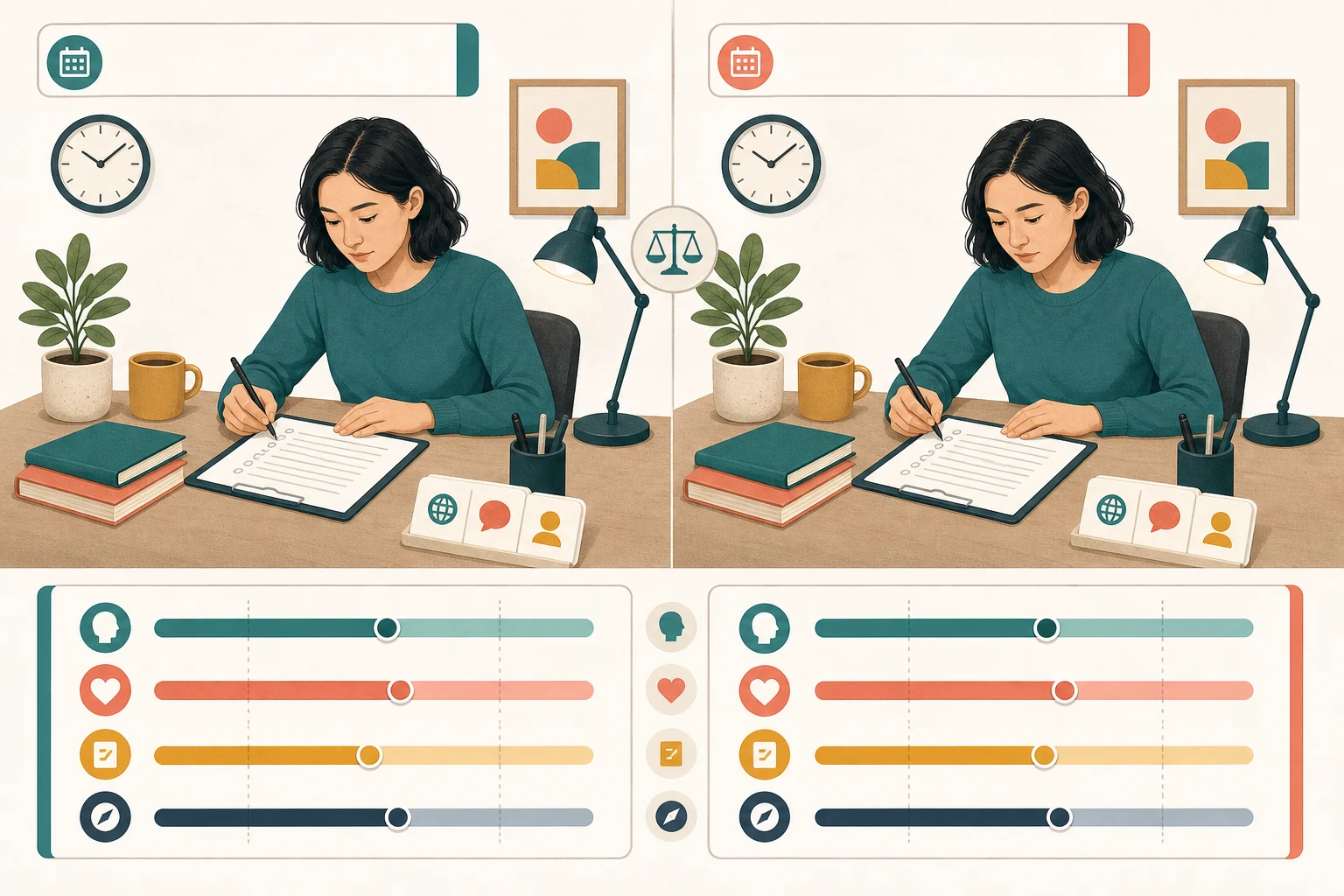
Keep the instrument version, language, time frame, and answering reference as consistent as possible. Record alertness, interruptions, and whether work or ordinary life dominated your examples. Compare movement on each dimension before comparing type labels.
An INFJ-to-INTJ change caused only by T/F moving from 48/52 to 53/47 is a small boundary shift, not a whole-personality replacement. If all dimensions move sharply, investigate translation, state, and version before creating two identity stories. A useful retest table contains the dimension, both scores, session conditions, and stable real-world evidence.
Sources and scope
- Standards for Educational and Psychological Testing supports the distinction among reliability, validity, fairness, and intended use. It does not validate a specific online test.
- The Myers-Briggs Company: MBTI Assessment supports the description of the official assessment as a researched instrument used with interpretation and development.
The 24-, 60-, and 80-item tests are fictional design comparisons. This page does not publish accuracy rates or certify any unofficial provider.
Related reading
Best MBTI Websites Hub: Choose by Job, Then Leave This Page
Hub-only page that sorts reading jobs and sends post-test and type-description intents to their owner pages instead of ranking every site here.Is MBTI accurate? What it can help with, and what it should not replace
A question page about MBTI accuracy, usefulness, and limitations.MBTI Test Questions: What They Measure and How to Answer Honestly
Evaluate question quality and answer from ordinary repeated behavior instead of ideals, job demands, or one exceptional week.Keep exploring
Take the test to see your type, or browse more MBTI guides and answered questions.