
Contextual article
If Two MBTI Types Both Fit, Does That Mean You Are a Mixed Type?
24 min read
· By itypelab Editorial Team
· 2026-07-20
A mixed-type feeling usually comes from a close dimension, role adaptation, or broad descriptions; preserve uncertainty and compare both candidates in the same scene.
Best for readers who already know MBTI and want to connect it to real work, relationships, or self-observation.
This article breaks a common MBTI topic into more usable signals instead of stopping at a quick answer.
You'll leave with a clearer interpretation frame and a better sense of whether to continue into a type page, question page, or guide.
If two MBTI profiles both fit, that usually does not mean you have a new “mixed type,” and it does not imply two fixed personalities. It signals unresolved classification evidence: one dimension may sit near the boundary, a work role may alter visible behavior, both profiles may be broad, or learned skill may be standing in for preference.
This does not require forcing a label immediately. “INFJ is the current best hypothesis, but T/F remains uncertain” can be more accurate than inventing two complete personalities to explain every setting.

A categorical code compresses continuous differences
Suppose a report shows I 68%, N 72%, F 51%, and J 64%. It must print four letters, so it returns INFJ. Yet 51/49 on T/F does not carry the same certainty as 72/28 on N/S. The code hides that difference.
| Result pattern | Better interpretation | Unsupported leap |
|---|---|---|
| One-letter difference and a 51/49 score | One preference boundary lacks clear evidence | Two complete fixed types coexist |
| Work and home results differ | Role demands or answering references differ | One daytime personality and one nighttime personality |
| Both descriptions contain broad strengths | The writing has weak discrimination | Both types have been confirmed |
| Codes differ by three letters | Recheck state, test quality, and self-observation | The whole personality switched quickly |
| The same boundary repeats for months | Preserve uncertainty and compare process | Retest until a preferred code wins |
The official MBTI Basics builds type from four preference pairs. A preference does not mean exclusive behavior or absence of skill on the other side. The category describes a relative tendency, not a sealed behavioral box.
Diagnose which version of “both fit” you have
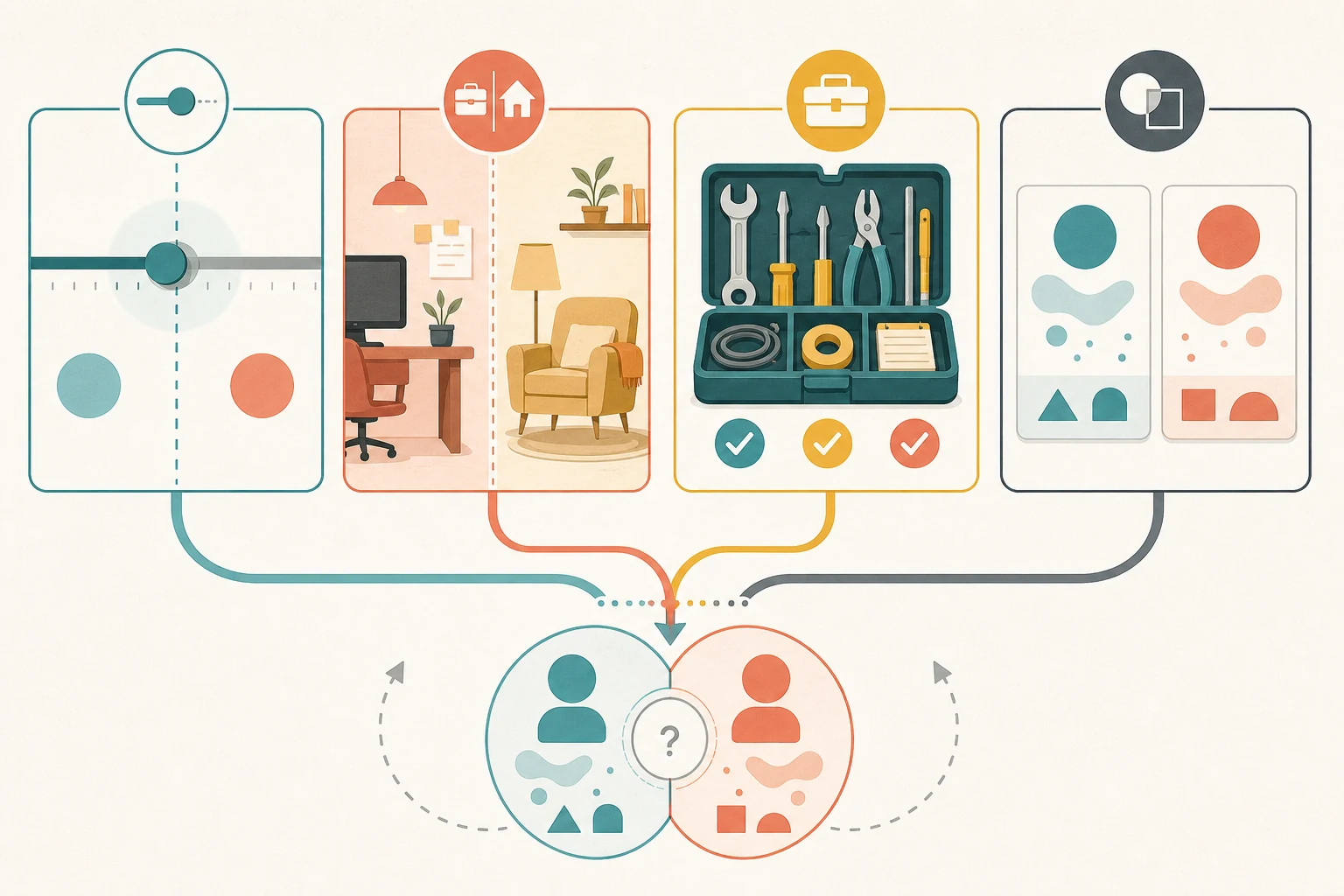
| Likely cause | Identifying signal | Next move |
|---|---|---|
| Close dimension | Codes differ by one letter and the score is near midpoint | Test first reactions in one shared conflict |
| Context adaptation | The other side appears mainly at work, caregiving, or under pressure | Compare accountable and low-obligation scenes |
| Skill-preference confusion | “I present well, so E” or “I plan well, so J” | Separate ability, spontaneous use, and recovery cost |
| Generic profiles | Both pages say creative, loyal, strategic, or empathic | Remove adjectives and retain predicted actions |
| Changed answering state | Results shift during burnout, transition, or sleep loss | Return to an ordinary stable reference period |
The purpose is not a quick label. It is locating the layer of uncertainty before reading more profiles.
Case one: INFJ versus INTJ is not warm versus analytical
Maya is attentive to interviewees' discomfort and strict about removing claims unsupported by evidence. INFJ's relational sensitivity and INTJ's analytical reputation both sound right.
Use one conflict: data supports removing a feature, while sales has made a promise to long-term customers. Maya first maps what the promise means for trust, then seeks an evidence-consistent transition and message. Another person may establish a product decision standard first, reach the removal decision, and then design the customer response. Both may care about people and evidence. The difference is which judgment organizes the problem first.
Only repeated order across product, family, and collaboration decisions becomes discriminating evidence. One warm conversation or decisive action does not.
Case two: ENFP versus ENTP depends on what closes exploration
Alex generates ideas, enjoys argument, and cares about friends. ENFP's value language and ENTP's logic language both fit.
The team proposes a high-performing campaign with a misleading implication. Once factual and performance questions are resolved, the ENFP hypothesis predicts that Alex may still reject it because it violates a commitment Alex is willing to represent. The ENTP hypothesis predicts that if definitions, evidence, and user expectations become coherent, the proposal can reopen.
This is not “F lacks logic” or “T lacks values.” It asks which judgment receives earlier veto power when both cannot be satisfied. Record several decisions with the nearby-type comparison method instead of collecting trait lists.
Case three: ISFJ versus ISTJ cannot be solved by caring versus rules
A hospital scheduling lead remembers colleagues' family constraints and insists every shift swap be documented. One observer says ISFJ; another sees ISTJ.
During an emergency absence, both hypotheses may produce help. The distinction is how a repeatable rule is built. Does the lead protect a concrete relational commitment first and document the exception for fairness, or protect a universally applicable standard first and accommodate the individual within it? Real people use both. The question is what becomes hardest to sacrifice under conflict.
“Cares for people” and “follows rules” are outcomes, not type-specific evidence. A complete case includes pressure, competing protected objects, and the final tradeoff.
A six-step comparison instead of twenty profile pages
1. Put the codes side by side and circle only the differing letters. 2. Preserve score closeness; do not treat 51/49 like 85/15. 3. Delete shared praise such as smart, kind, independent, or creative. 4. Select three repeated scenes: an ordinary choice, a relationship conflict, and a consequential task. 5. Write a different prediction for each hypothesis. A prediction that fits every outcome has no discriminating power. 6. Record one recurring behavior that would weaken each candidate.
| Scene | Candidate A predicts | Candidate B predicts | Actual first move | Hypothesis weakened |
|---|---|---|---|---|
| A plan is canceled | Restore closure first | Open alternatives first | ||
| A friend demands loyalty | Check relational commitment first | Check argument consistency first | ||
| A task goal is vague | Define deliverable criteria first | Expand the problem model first |
Record what you protect first, what evidence changes your mind, and which unresolved state is hardest to tolerate. If no difference appears after several cases, preserving uncertainty is better than adding a story.
Prevent role behavior from becoming a second type
A teacher can lecture for hours without interaction being the preferred recovery source. An INFP operations coordinator can maintain strict checklists because dropped handoffs have consequences. An ESTP caregiver can become cautious without a permanent preference reversal.
Ask three questions: Would I initiate this behavior without consequences? Does it provide energy or require recovery? When the pressure ends, do I keep the method or quickly return to another rhythm?
If the split is mainly work versus home, use the answering-context guide. If it appears only during acute stress, stabilize the condition before naming the behavior as another type.
Give different evidence different weight

Not every type-like behavior is equally informative. Public, required, heavily trained, one-off behavior is easily shaped by role. Unsupervised, unrewarded, repeated choices that persist despite a real cost provide stronger preference evidence.
| Evidence | Why its weight may be low | How to improve discrimination |
|---|---|---|
| Speaking first in company meetings | Performance expectations are strong | Observe idea formation in optional discussions |
| Planning one trip in detail | Travel companions may require it | Compare several solo trips and reactions to change |
| Comforting a friend first | Social norms and relationship stakes matter | Observe which judgment ultimately controls the tradeoff |
| Organizing ambiguity without being asked | External reward is lower and the pattern repeats | Record energy cost and what feels intolerable if left undone |
Do not count which side has more actions. Compare the conditions under which behavior appears automatically, the cost of suppressing it, and whether it remains after pressure ends.
When to stop forcing a category
Long-term close dimensions, weak test documentation, too few life samples, and major transitions are valid reasons to remain uncertain. MBTI is a language for observation, not mandatory identity registration.
Keep the clinical boundary clear. Identifying with two type descriptions is not evidence of dissociative identity or another condition. MBTI cannot diagnose mental health. Distressing memory gaps, identity disruption, or functional impairment belong with qualified professional care, not self-diagnosis through type content.
The testing standards open-access resource emphasizes interpreting results within evidence and intended use. For personal reading, the minimum implication is simple: do not make a boundary score carry certainty it did not provide.
Use the close-dimensions guide and the result deep-reading checklist next. The objective is not to prove that you can own only one label. It is to retain the hypothesis that best predicts repeated patterns and survives counterevidence.
Sources and scope
- Myers & Briggs Foundation: MBTI Basics supports the official four-preference foundation.
- Standards for Educational and Psychological Testing supports the evidence-and-intended-use boundary for test interpretation.
The 51/49 example and all three cases are instructional. They do not diagnose a person or establish that one behavior necessarily belongs to one type.
Related reading
MBTI Test Complete Guide: personality types, accuracy, careers, relationships, and how to use the results
A complete guide to the MBTI test, the 16 types, result reading, and practical use cases.Is 16Personalities the same as MBTI? Similar surface, different logic
A direct-answer page on how 16Personalities differs from MBTI in theory, wording, and interpretation.Why Is MBTI So Popular in Korea? Five Concrete Reasons
Four letters are memorable, shareable, and easy to use in conversation; Korean entertainment and social life gave them many places to circulate.Keep exploring
Take the test to see your type, or browse more MBTI guides and answered questions.